
Introduction
Hydrogen Sulfide (H2S) is often called the Silent Killer; it is one of the most dangerous gases. It occurs naturally and is found in various geological formations. This H2S safety training will give you the knowledge you need to stay safe when working in areas where H2S may be present, empowering you to respond effectively to potential hazards.
H2S Major Incidents:
We have included some of the fatality incidents in this H2S safety training, not to scare you, but to point out how H2S is a silent killer.
- A rig worker collapsed while operating a blow-out preventer valve. The foreman brought a breathing apparatus to rescue him but was overcome as well. They removed them from the area. The third worker was revived, but the first worker and the foreman both died.
- After loading his tank truck with sour produced water, the driver climbed onto the tank to gauge his load. His body was found the next morning on top of the tank near the open hatch.
- A boiler foreman was exposed to hydrogen sulfide while removing a blind on top of a vessel. After the exposure, he fell 12m to his death.
How H2S Safety Training help
By seeing the above fatality incident, by the end of the H2S safety training, you will be able to understand how to control these hazards
- Properties of H2S
- Location of H2S.
- Health Hazards of H2S.
- Initial Response Strategy
Also, organizations in the oil and gas industry focus on ensuring their workers’ safety, and they provide the following to workers who are working or visiting in such an industry
- Receiving adequate H2S Safety training.
- Pre-job planning.
- Emergency response planning.
- Controlling hazards.
- Using breathing apparatus.
What is H2S Gas?
Hydrogen Sulfide (H₂S) is a colorless, highly toxic, and flammable gas commonly found in oil and gas operations.
Property of H2S Gas
To understand what H2S is and how it behaves, you need to know its properties. In this section of H2S safety training, we highlighted some of the key properties of H2S Gas.
| PROPERTIES | DESCRIPTION |
| Physical State | Normally encountered as a gas |
| Color | Colorless No visible sign of H2S to warn you of its presence. |
| Odor | Smells like “rotten eggs” Impairs your sense of smell at low concentrations. Don’t rely on your sense of smell to detect H2S |
| Vapor Density | Heavier than air It may flow or settle in low laying areas like pits, trenches and Natural depressions |
| Flammability | Flammable Burns with a blue flame and off Sulfur dioxide gas, SO2 SO2 is hazardous and irritates the eyes and the respiratory system. Explosive when mixed with air. |
| Solubility | Dissolve in water, sludge, emulsions, well fluids and molten Sulfur H2S is released when liquids are agitated, depressurized or heated. |
Note: H2S is soluble in liquids; be careful when dealing with liquids, especially in oil refineries, e.g., when depressurizing any system, vessel, tank, etc. that may contain a liquid with H2S in it. Depressurizing the system releases dissolved H2S, which may become a hazard.
Common Location
Worker in following area is at high risk of exposure with H2S.
Drilling Operations
- Well testing areas
- Mud logging units
- Shale shakers and mud pits
Production & Processing Plants
- Separators and storage tanks
- Gas treatment units
- Sulfur recovery units
Maintenance Activities
- Confined space entry (tanks, vessels)
- Pipeline maintenance
- Cleaning operations
Common areas where H2S release occur are
- Seals
- Fittings
- Flanges
- Drains
- Samples valves
- Relief valves
- Vent Lines
Note: If you’re near equipment handling liquids or carbohydrates, always observe wind socks to determine the wind’s direction. Knowing this helps you stay alert and prepared to avoid danger from gas accumulation near ground level.
Health Hazards
In this H2S Safety training, we highlight the serious health hazards of H2S gas, which is highly poisonous. Extreme caution and special controls are required to mitigate these hazards. H2S affects the body quickly, mainly the respiratory and nervous systems. To understand health hazards, we must know the concentration of H2S in the air because each concentration has different health hazards.
Exposure Effects by Concentration:
| Concentration | Effects |
| Low (10–20 ppm) | Eye irritation, headache |
| Medium (50–100 ppm) | Severe coughing, breathing difficulty |
| High (100+ ppm) | Loss of smell, unconsciousness |
| Very High (300+ ppm) | Immediate collapse, death |
Note: Keep in mind, the above-mentioned limit is only to understand the effect on the body at those concentrations. The Occupational Exposure Limit (OEL) applies to working in an H2S Environment.
Occupational Exposure Limits (OEL)
Government regulations, OSHA, IOSH, and oil and gas companies set limits for worker exposure to toxic substances. Working with these levels is safe for workers in day-to-day work in an H2S-concentrated environment.
We add this table for your better understanding in this H2S safety training, please refer below for OEL
| OCCUPATIONAL EXPOSURE LIMITS | CONCENTRARTION | OEL DESCRIPTIONS |
| 8 Hour OEL | Less than or equal to 10PPM | A time-weighted average (TWA)maximum Exposure for an eight hour work day. |
| 15 Minute OEL | Above 10 or equal to 15 PPM | A TWA exposure limit of up to 15 minutes With a 60minutes separation between each Exposure. |
| Ceiling OEL | Above 15 or equal to 20 PPM | No one should be exposed to greater than 20 PMM of H2S at any time without adequate respiratory Protection. |
Essential H2S Safety Training Components
Hope you have built better understanding so far, below are some training components which will help you to protect you and others.
1. Hazard Awareness
Workers must understand:
- What H₂S is
- Where it can be present
- Why it is dangerous
2. Gas Detection Systems
- Fixed gas detectors installed in plants
- Portable personal H₂S monitors (mandatory for workers)
Always ensure your gas detector is:
- Calibrated
- Bump tested
- Worn in the breathing zone
3. Personal Protective Equipment (PPE)
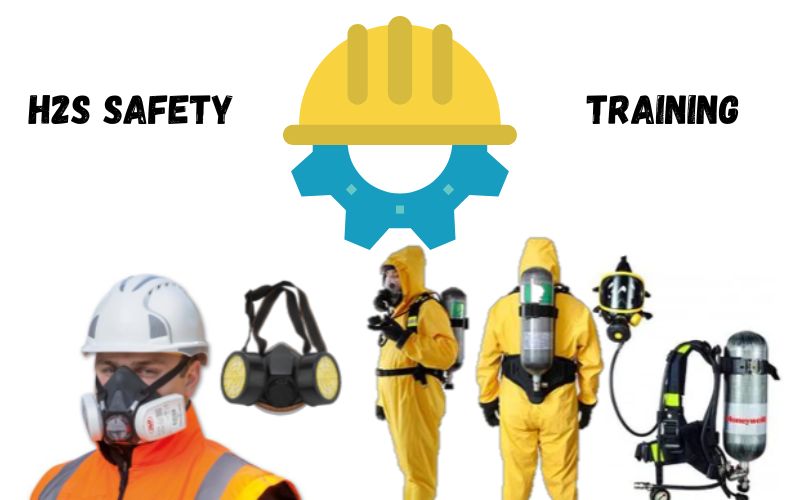
Critical PPE for H₂S environments includes:
- Escape breathing apparatus (EEBA)
- Self-Contained Breathing Apparatus (SCBA)
- Flame-resistant clothing
- Safety goggles and gloves
You must be trained on:
- Proper use
- Inspection
- Emergency deployment
4. H2S Emergency Response Procedures
In case of H₂S detection or alarm:
Immediate Actions:
- Stop work immediately
- Hold your breath if necessary
- Move upwind or to higher ground
- Wear your escape respirator
Do NOT:
- Panic
- Attempt rescue without proper breathing equipment
- Ignore alarms
Summary
H₂S is a hidden and deadly threat in the industry. Proper training, awareness, and safety practices can make the difference between life and death. Every worker in drilling, production, or plant operations must take H2S safety seriously. We hope this H2S safety training highlights the importance of always following procedures, using the right PPE, and never underestimating the danger.
About the author
Adil Ahmed — HSE Officer. 4+ years across oil and gas EPC projects, drilling rig operations, refinery operations, brownfield tank farm expansion and shutdown/turnaround (TAR) work in the Middle East and South Asia, covering permit to work, JSA/JHA, risk assessment, confined space entry, lifting operations and hot work.
Qualifications: NEBOSH International General Certificate in Occupational Health and Safety · IOSH Managing Safely
See project experience → · Follow SafetyOG on LinkedIn
General guidance only. Standards and requirements vary by company, country and permit system — always follow your own site’s approved procedure.