
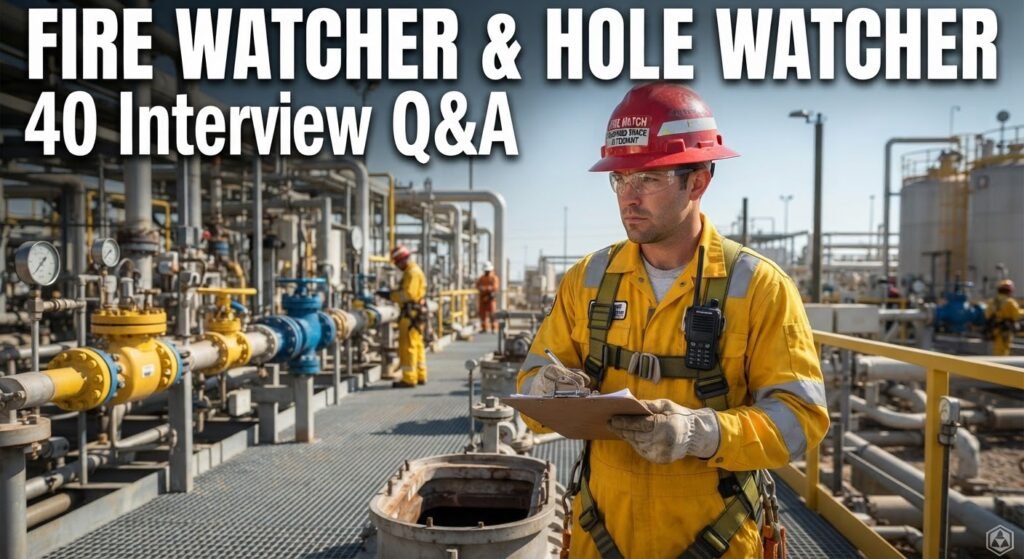
In the Middle East oil and gas sector, companies like Saudi Aramco and SABIC enforce zero-tolerance safety policies. Fire Watcher and Hole Watcher (Standby Men) serve as the final barrier against major refinery fires and toxic gas incidents.
Fire Watcher Key Responsibilities
- Pre-Work Checks: Verify the Hot Work Permit (HWP) and Job Safety Analysis (JSA). Ensure flammable materials within 35 ft (11 m) are removed or covered with fire blankets. Inspect fire extinguishers (gauge in green, pin/seal intact).
- Active Watch: Maintain uninterrupted visual contact during hot work. Never engage in secondary helper duties—monitoring is your sole responsibility.
- Post-Work Monitoring: Remain on site for at least 30 minutes after work stops to ensure no hidden embers or sparks reignite.
- Emergency Response: Apply the PASS method on small fires. Follow F-I-R-E (Find, Inform, Restrict, Extinguish/Evacuate) and raise site alarms immediately if uncontained.
Hole Watcher (Standby Man) Key Responsibilities
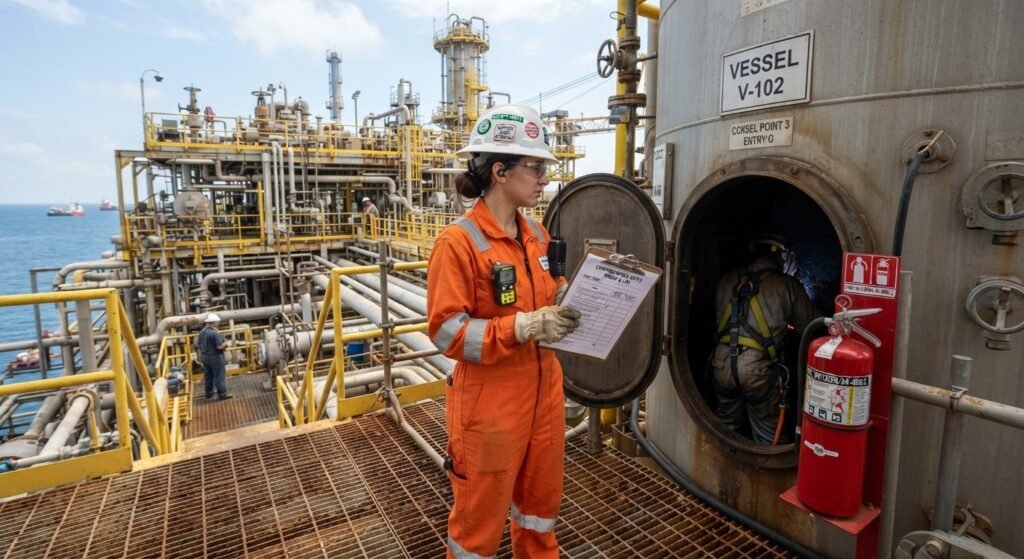
- Entry Control: Maintain the Confined Space Entry Register (Log Sheet) and Tally Board hanging entrant badges. Verify that entrants are authorized before the entry plan.
- Gas Monitoring Compliance: Confirm continuous gas testing parameters:
- Oxygen (O2): 19.5% to 23.5%
- Combustibles (LEL): Below 10% (0% for hot work)
- Toxic Gases: H2S<10 ppm, CO<35 ppm
- Continuous Communication: Maintain verbal, whistle, radio, or lifeline contact with entrants.
- Non-Entry Emergency Action: NEVER ENTER THE CONFINED SPACE. Sound the air horn, alert the ERT, and use external mechanical retrieval systems (a tripod winch connected to the entrant’s back D-ring).
40 Interview Questions & Answers For Fire Watcher and Hole Watcher (Saudi Arabia Oil & Gas Focus)
Section 1: Core HSE & Risk Management
Q01: What is HSE?
A: Health, Safety, and Environment—preventing workplace harm or illness by maintaining controlled, safe working conditions.
Q02: What is the difference between a Hazard and a Risk?
A: A hazard is anything with the potential to cause harm (e.g., H2S gas, welding arc). Risk is the combination of likelihood and severity (Risk=Likelihood×Severity).
Q03: What are the 5 steps of a Risk Assessment?
A: 1) Identify hazards, 2) Decide who might be harmed, 3) Evaluate risks and precautions, 4) Record findings, 5) Review and update.
Q04: What is the difference between an Incident and a Near Miss?
A: An incident results in actual injury or equipment loss. A near miss has the potential for loss but results in none.
Q05: What is an MSDS / SDS?
A: Material Safety Data Sheet; details chemical properties, health hazards, flammability, handling rules, and emergency controls.
Q06: What is the Hierarchy of Risk Control?
A: Elimination, Substitution, Engineering Controls, Administrative Controls, and Personal Protective Equipment (PPE).
Q07: What essential documents must you check before starting work?
A: Valid Work Permit (HWP or CSE), JSA, Rescue Plan, and Toolbox Talk (TBT) attendance.
Section 2: Fire Safety & Fire Watching
Q08: What forms the Fire Triangle and Tetrahedron?
A: Triangle: Oxygen, Heat, Fuel. Tetrahedron adds the uninhibited Chemical Chain Reaction.
Q09: What are the principles of heat transmission?
A: Convection (heated gases/air), Conduction (direct transfer through solids), and Radiation (heat waves).
Q10: What are the three methods of extinguishing a fire?
A: Starvation (removing fuel), Smothering (cutting off oxygen), and Cooling (reducing temperature below ignition point).
Q11: How are fires classified in plant facilities?
A:
- Class A: Solids (wood, paper, rubber)
- Class B: Liquids & gases (gasoline, paint, propane)
- Class C: Energized electrical equipment
- Class D: Combustible metals (magnesium, sodium)
- Class K/F: Commercial cooking oils/fats
Q12: Which fire extinguisher types are standard on site?
A: Dry Chemical Powder (DCP for A, B, C, D), Carbon Dioxide (CO2 for C/electrical), Pressurized Water (Class A), and Foam/AFFF (Class A, B).
Q13: What are the standard color codes on fire extinguishers?
A: Water (Signal Red), CO2 (Black band), DCP (Blue band), Foam (Cream band).
Q14: What does PASS stand for?
A: Pull the pin, Aim at the base of the fire, Squeeze the handle, Sweep side-to-side.
Q15: What is the F-I-R-E protocol in a site emergency?
A: Find the fire, Inform ERT, Restrict/contain, Extinguish or Evacuate.
Q16: What is the difference between Flash Point and Fire Point?
A: Flash point is the lowest temperature at which a liquid produces enough vapor to ignite briefly. The fire point is slightly higher, where vapors sustain burning for 5+ seconds.
Q17: How do you safely use a fire blanket?
A: Turn off the heat source if safe, pull the tapes to release, wrap corners around hands for protection, and place over flames to smother.
Q18: How long must a Fire Watcher remain after hot work?
A: Minimum 30 minutes (or up to 1 hour per specific plant hot work permits).
Q19: Can a Fire Watcher act as a welder’s helper?
A: No. Fire watching requires 100% continuous monitoring with zero side duties.
Section 3: Hole Watching & Confined Space Safety
Q20: What is a Confined Space?
A: A space large enough to enter bodily, with limited entry/exit, not designed for continuous human occupancy (e.g., vessels, tanks, manholes, trenches).
Q21: What are acceptable oxygen levels for entry?
A: 19.5% to 23.5% by volume.
Q22: What is LEL, and what is the entry limit?
A: Lower Explosive Limit. LEL must be <10% for entry and 0% for hot work inside.
Q23: What does IDLH mean?
A: Immediately Dangerous to Life or Health—conditions posing an immediate hazard to life or irreversible health damage.
Q24: What are the key hazards of Hydrogen Sulfide (H2S)?
A: Highly toxic, flammable, heavier than air (collects in low areas), smells like rotten eggs at low concentrations, but deadens the smell instantly at high levels.
Q25: What is the golden rule for a Standby Man during an emergency?
A: NEVER ENTER THE CONFINED SPACE. Perform non-entry rescue only and call ERT.
Q26: What equipment must be at the confined space entrance?
A: Entry log sheet, Tally board, continuous multi-gas monitor, air horn, walkie-talkie, and tripod winch hooked to entrant’s harness.
Q27: When is a person considered inside a confined space?
A: The moment any part of their body breaks the plane of the entrance.
Q28: What do you do if you must leave your post as a Hole Watcher?
A: Order all entrants out, collect badges, shut the entrance, mark “DO NOT ENTER”, and notify the CSE supervisor.
Section 4: Plant Equipment, PPE & Standards
Q 29: What PPE is mandatory for fire watcher and hole watcher?
A: Hard hat, safety glasses/face shield, high-visibility vest, leather gloves, safety boots, and personal multi-gas detector.
Q 30: What is SCBA and when is it required?
A: Self-Contained Breathing Apparatus. Required in oxygen-deficient (<19.5%) or toxic (H2S/CO) IDLH environments.
Q31: What are the rules for emergency exit routes?
A: Unobstructed, min 7 ft height, min 28 inches width, clearly marked/illuminated, and lock-free from the inside.
Q32: What is a Muster Point?
A: A designated safe assembly area upwind of plant hazards used for headcounts during evacuation alarms.
Q33: What is NFPA and its primary standard for extinguishers?
A: National Fire Protection Association. The standard for portable fire extinguishers is NFPA 10.
Q34: What do the colors in the NFPA 704 Diamond represent?
A: Blue = Health, Red = Flammability, Yellow = Instability/Reactivity, White = Special Hazards (e.g., W with a line = Water Reactive).
Q35: What pre-use checks are needed for a fire extinguisher?
A: Pressure gauge in the green, hose clear, pull pin and seal intact, body free of damage/rust, and tag valid.
Q36: What is mechanical ventilation in confined spaces?
A: Using forced-air blowers or extractors to continuously push fresh air into the space and remove toxic vapors.
Section 5: Scenario & Field Practice
Q37: Hot slag drops near a process pipe during grinding. What do you do?
A: Stop work, extinguish embers, reposition fire blankets underneath, re-check area with gas monitor, then permit restart.
Q38: An entrant collapses inside a vessel. What is your action sequence?
A:
- Sound air horn.
- Call ERT/Control Room with exact location.
- Crank mechanical retrieval winch to pull entrant out.
- Do not enter. Await ERT.
Q39: How do high wind speeds affect elevated hot work in desert gas plants?
A: High winds (>20 km/h) carry sparks past fire blankets into operational units. Stop hot work immediately.
Q40: Why is housekeeping essential before hot work?
A: Removing trash, oily rags, and wood deprives potential fires of fuel, eliminating one leg of the Fire Triangle.
About the author
Adil Ahmed — HSE Officer. 4+ years across oil and gas EPC projects, drilling rig operations, refinery operations, brownfield tank farm expansion and shutdown/turnaround (TAR) work in the Middle East and South Asia, covering permit to work, JSA/JHA, risk assessment, confined space entry, lifting operations and hot work.
Qualifications: NEBOSH International General Certificate in Occupational Health and Safety · IOSH Managing Safely
See project experience → · Follow SafetyOG on LinkedIn
General guidance only. Standards and requirements vary by company, country and permit system — always follow your own site’s approved procedure.
Pingback: HSE officer interview questions and answers - Part 3 - Safety OG