
Introduction
If you work in oil and gas, construction, or any industrial environment, you already know that hazards are everywhere; hazards alone do not cause accidents, but uncontrolled hazards do. This article’s risk assessment can be effectively applied on-site.
In this article, you will walk through risk assessment step by step, understand how hazards are connected using a practical risk matrix, and then apply the Hierarchy of Control to reduce the effects of those hazards, known as risk.
Before we talk about risk assessment and control implementation, we must clearly understand hazards.
What is a hazard?
If we define a hazard specifically for an oil and gas site, it is anything with the potential to cause harm to people working on-site, damage to property or equipment, or an impact on the environment.
Hazards Identification
Hazards always arise from a source. To measure risk or conduct a risk assessment, we identify the appropriate sources of hazards. This will also help in deciding on effective control.
To identify hazards in the oil and gas industry, some common sources are:
Electrical: powerlines, energized equipment
Gravity: a falling object, a collapsing scaffolding
Mechanical: rotating equipment, motors, drive belts
Motion: vehicle, equipment movement, manual lifting
Pressure: gas cylinder, pressure piping, vessels
Radiation: Welding arc, X-rays, NORM
Sound: equipment noise, high-pressure relief noise, vibration
Temperature: open flame and ignition source, hot or cold surface, steam
Biological: animals, viruses, bacteria
Chemical: Flammable gas, corrosive, inert gas
Note: Hazards are always present; we cannot eliminate them. However, once we identify the hazards and their sources, we can control the risks they create.
What is Risk?
Risk is the effect or consequence of a hazard. Usually, it is measured in the combination of:
- Severity (how bad the outcome is)
- Probability (how likely it is to happen)
Equation formed
Risk = Severity x Likelihood
Example:
A person is doing oxyacetylene welding. There is a list of hazards associated with this activity, like fire, explosion, and lightning from welding
Hazard: Lightning
Risk: Lightning or intense welding arc flash can cause eye damage to welders or nearby personnel.
Note: A hazard creates the potential for harm, while risk defines the level of danger associated with that hazard.
Risk Assessment
Risk assessment is the process of identifying hazards, evaluating and measuring the associated risks, and applying controls to reduce the overall level of risk.
To assess hazard risk, a tool called a Risk Matrix is used to define the level of risk. In the picture below, you can see:
RAM (Risk Assessment Matrix)
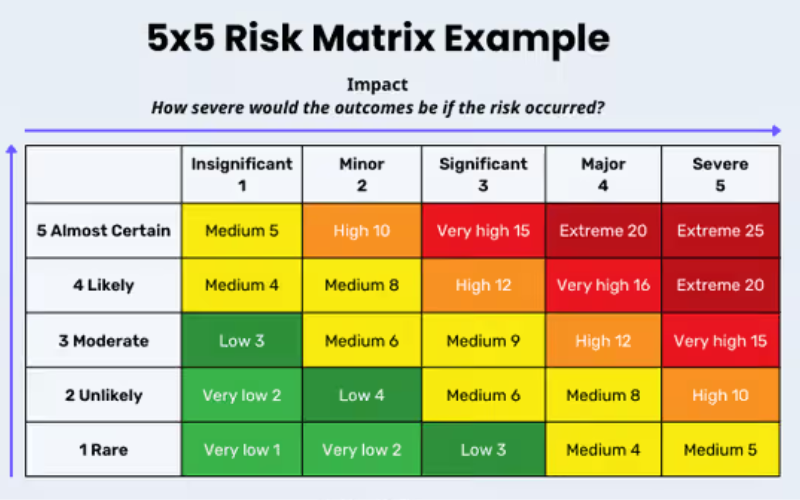
On the Vertical side, numbers are 1 to 5; each box contains 20% value, meaning 1 to 5 is 100%, and the same on the horizontal side
Severity Levels:
- Low – Green
- Medium – Yellow
- High – High
Probability/ Likelihood
- Rare
- Possible
- Likely
Example Risk Assessment: Real Scenario
The welding example we discussed above contains
Hazard: lightning produced through welding
Risk: Eye Damage.
Now, evaluate the risk degree with the help of the Risk Matrix
Severity: High – So number 5. As disability or fatality, 80 to 100 in severity.
Probability: High – So number 5. As it’s likely because lightning is continually produced through welding
Risk Degree: 5*5 = High – Not acceptable.
Note: In the oil and gas industry, a high level of risk or risk assessment is not acceptable. It must be reduced to a medium or low level before any task can be carried out safely.
Hierarchy of control
The Hierarchy of Control is a structured way to reduce risks, from most effective to least effective:

1. Elimination (Most Effective)
Remove the hazard completely.
Best solution—but not always practical.
2. Substitution
Replace the hazard with something safer.
3. Engineering Controls
Isolate people from the hazard. This means modifying the system to separate workers from the hazard.
4. Administrative Controls
Change the way people work. It focuses on workers’ behavior toward safety.
5. Personal Protective Equipment (PPE) (Least Effective)
Protect the worker with equipment.
Applying the Hierarchy of Control to Our Example
Keep the welding example in mind
Hazard: Lightning
Risk: Eye Damage
Risk Assessment = High (Not Acceptable)
Applying control by using the hierarchy of control
Elimination: This control suggests removing this hazard completely, but if not possible,
Substitution: This is also not possible; we can’t change the welding activity.
Engineering: For lightning, control can be limited or less effective in preventing it from occurring
Administrative controls: We can influence workers’ behavior to ensure they comply with effective safety measures and controls.
PPE: Shaded safety goggles can reduce the impact of lightning on workers’ eyes, reducing the overall risk.
Risk Assessment After control
After applying the control: the use of shaded safety goggles
- Severity: Reduced to Low, number 2
- Probability: Still High, number 5.
- Risk = 2 x 5, which is 10
Risk Level becomes Medium (Now Acceptable with controls)
Another Example Work at height:
A work example: working on an elevated platform,
Hazard: Work at height
Risk: Falling from height
- Severity: High (If a person falls from height, they can be disabled or die)
- Probability: Medium (It is possible a person can fall)
Risk Assessment:
Risk = 5×3
This is 15, which means the overall risk is high and not acceptable
Applying control by using the hierarchy of control
Elimination: Avoid working at height by pre-assembling on the ground. Risk is eliminated, but if it is not possible.
Substitution: Not possible for this scenario.
Engineering Controls: Install guardrails, mid-rails, toe boards, and proper working platforms. This will help in a major reduction in falls.
Administrative Control: Improve workers’ safe behaviour to comply with PTW.
Proper use of a full-body harness is the final layer of protection or control.
Risk Assessment After control
After applying the Control
- Severity: Still high
- Probability: Reduced to low
- Risk = 2 x 5
Risk Assessment is 10, which reduces to a medium level and is now acceptable.
Both examples and isabove clearly explain the use of a risk assessment matrix and hierarchy of control
Note: Never start controls with PPE, as this is the least effective in the hierarchy of controls. Always apply controls one by one; this helps reduce risk levels from high to low more effectively.
Summary:
As a safety officer or professional, the officer’s role is not only to identify hazards but also to effectively control the risks they create. This is done by following a structured approach: first, identify the hazards; then, assess their impact using a risk assessment and risk matrix; apply appropriate controls using the Hierarchy of Control; and finally, reassess the risk. This process helps reduce the overall risk level.
Pingback: Forklift Driving Safety Training - Safety OG
Pingback: General Safety Induction for Plant Oil and Gas. - Safety OG