
If you’ve ever stepped into a refinery shutdown, tank maintenance job, or coating activity in the oil and gas or chemical industry, you’ve likely seen sandblasting in action. It looks simple from a distance—but in reality, it is one of the highest-risk activities on site. That’s why Sandblasting safety training is not just a formality; it is a critical lifesaving requirement.
Introduction
Sandblasting, also known as abrasive blasting, cleans or prepares a surface by propelling abrasive material at high pressure. It is widely used in construction, fabrication, and maintenance work.
This article (sandblasting safety training) is written exactly the way a real safety officer or trainer explains it during a toolbox talk or site induction for sandblasting activity – simple, practical, and based on real industry conditions.
What Is Sandblasting in Real-World Conditions?
On-site, sandblasting is used for:
- Surface preparation before painting
- Rust and coating removal
- Cleaning tanks, pipelines, and structures
Associated things:
- High-pressure hoses
- Blasting pots
- Workers in full protective suits
- Dust clouds (if controls are poor)
This is where the risk begins, and proper safety controls are essential to protect workers, equipment, and the environment.
Inspection check List included Sand Blasting Safety Training
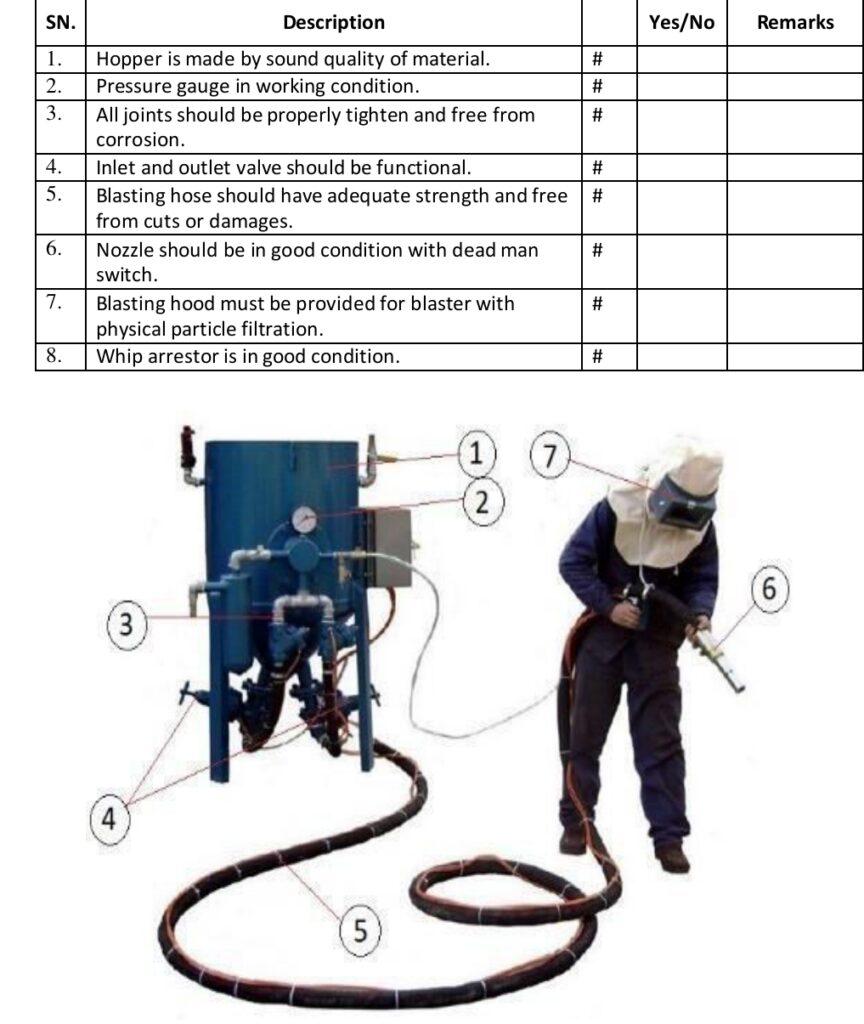
SandBlasting Safety Training Objectives:
- Understand real hazards associated with sand blasting, not just theory.
- Learning safe work procedure and emergency procedure.
- Identify require PPE and control measure to do job safely
Note: Most incidents happen because people don’t know their job because:
- Workers underestimate the risk
- PPE is used incorrectly
- Shortcuts are taken under pressure
- Supervisors fail to enforce controls
Major hazards
- Respiratory Diseases
This is the most dangerous hazard from inhaling dust and silica particles. Because they go directly into the lungs, you won’t feel it immediately, but they build up silently and can lead to diseases like silicosis.
- High-Pressure Injury Risk
Sandblasting equipment operates under high pressure. If anything goes wrong, the nozzle can cause serious injury, and direct contact can instantly damage the skin.
- Noise Exposure
Sandblasting operations and equipment run through a compressor and generator, producing continuous high noise. Without proper hearing protection, permanent hearing loss is possible, and this situation can also lead to communication breakdowns that can cause an incident.
- Poor Visibility and Dust
Flying particles of abrasive material can cause eye injury; during dust clouds, visibility drops to zero. These can have both short-term and long-term effects.
- Confined Space Hazards
In confined spaces like vessels and tanks, poor ventilation can lead to oxygen levels dropping, dust concentrations increasing, and rescue becoming difficult. Sandblasting in confined spaces requires a special permit(PTW) and active monitoring.
- Physical Hazards
Slip, trip, and falls from the work area, poor housekeeping, or debris cleanup.
Essential control measures:
- Proper documentation before the activity begins, a valid Risk Assessment and JSA prepared by an HSE Specialist or advisor, and compliance ensured by the site HSE officer.
- Approved Method work statement that includes safe work practices and defines complete roles and responsibilities.
- The permit-to-work system included proper hazard identification and selection of controls according to the JSA and Risk Assessment.
- Sand Blasting done by a certified and authorized worker, sand blasting equipment should be third-party and inspected and have valid certification
- Use only approved ballasting enclosures or barriers. Never point a blasting nozzle at anyone.
- Regularly inspect hoses, couplings, and nozzles. Use only dry and clean compressed air.
Personals Protective Equipment (Last line of defense)
In this sandblasting safety training activity, mandatory PPE is as follows
- Air-fed blasting helmet (not just a dust mask)
- Approved respirator system
- Full body protective suit
- Heavy-duty gloves
- Safety boots
- Hearing protection
Safe Work Procedure
In this sandblasting safety training, you will learn safe work practices for the following activities:
Before starting the Job
- Conduct a toolbox talk
- Inspect equipment (hoses, nozzles, compressor)
- Check PPE condition
- Ensure work permit is approved
- Confirm area isolation
During the Job
- Never point nozzle at any person
- Maintain safe distance
- Monitor dust levels
- Ensure continuous air supply to helmet
- Stay alert and communicate
After Completion
- Depressurize equipment safely
- Clean work area
- Store equipment properly
- Report any defects immediately
Environmental & HSMS Compliance
The environmental, Health, and Safety management system has established specific standards for this activity. The sandblasting safety training will state that this is mandatory to ensure compliance with these standards during this critical activity: sandblasting
- Follow local environmental regulations and the company’s internal HSE standards.
- Collect and properly dispose of spent abrasive material
- Prevent dust release into open environment
- Report all incidents, near miss, or unsafe conditions immediately
- Continuous monitoring for air quality and noise level
Emergency Procedure
Sand blasting safety training include steps:
- Stop sandblasting immediately in case of an accident or equipment failure.
- Provision of first aid secures the area to prevent any further harm and mobilizes the injured person to safe zone immediately
- Incident reporting to the supervisor and the area HSE immediately
- Do not restart blasting until the area is declared safe and all permit revalidation procedures have been completed.
- Keep a fire extinguisher and first-aid kit available near the work area
Common Mistakes Observed on Site
- Using normal masks instead of air-fed helmets
- Ignoring small air leaks in hoses
- Removing PPE for comfort
- Poor supervision
- No proper barricading
Conclussion
Sandblasting involves serious hazards if not properly controlled. Following safe work practices and using required PPE can reduce the overall risk of this critical activity. During the activity, maintain proper housekeeping and conduct equipment checks. Please prepare for any emergency, and ensure every worker involved in the activity is well aware of the emergency response plan.In the end, safety is everyone’s responsibility.