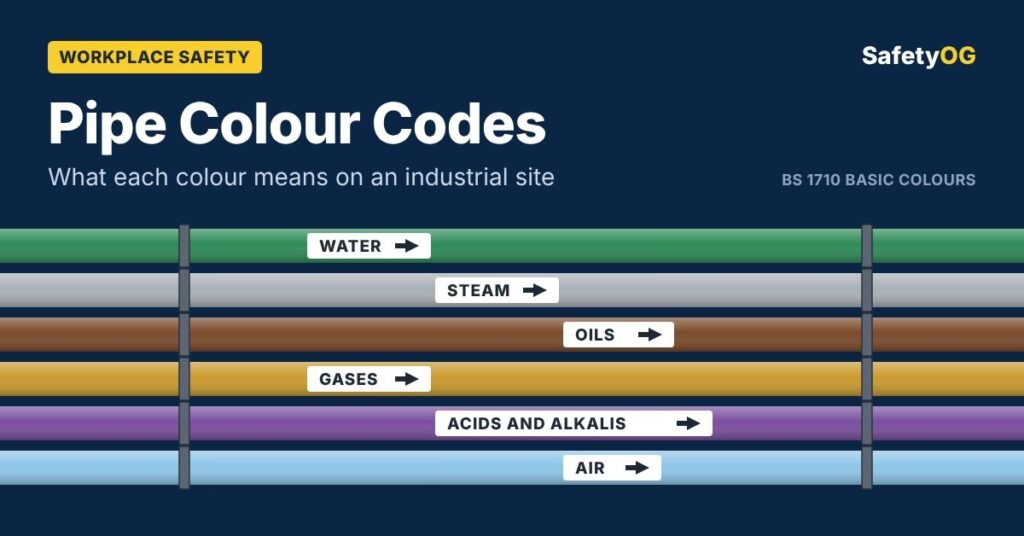
Here is an illustrative situation. A fitter is told to open the line on a unit he does not usually work on. The pipe is brown. At his last site, brown meant oil. Here, the paint is old, the label has peeled off and nobody on the crew is sure. This is the moment when pipe colour codes either help or mislead.
This guide explains how pipe colour coding works, the main schemes used in industry (the US ASME A13.1 and the UK BS 1710), where they agree and where they conflict, and why colour should never be your only way of identifying what is in a pipe. It is written for new workers, supervisors and HSE officers, and for anyone preparing for a safety interview.
Key takeaways
- There is no single worldwide pipe colour code. The US, the UK and the marine industry each use their own scheme, and sites often add their own rules.
- Some colours are fairly consistent: green for water and red for fire-fighting. Others change meaning between schemes, so never assume.
- Colour tells you roughly what a pipe carries. The label, flow arrow and line number tell you exactly. Before breaking containment, confirm the line with the permit, the isolation certificate and the P&ID.
- Charts shared on social media can mix several schemes together. Use your site’s own standard, or the standard itself.
Why Pipes Are Colour-Coded and Labelled
A process plant has hundreds of lines carrying water, steam, air, oil, gas, chemicals and fire-fighting water, often side by side on the same rack. Identification helps people to:
- recognise what a pipe carries and how hazardous it is
- know which line to isolate, and which not to touch
- respond faster in an emergency, for example to find fire water or shut off a fuel line
- avoid connecting the wrong hose or tool to the wrong service
Marking is a communication tool, not a control on its own. It supports the safe systems of work described in our permit to work guide and the hazard awareness taught in the general safety induction.
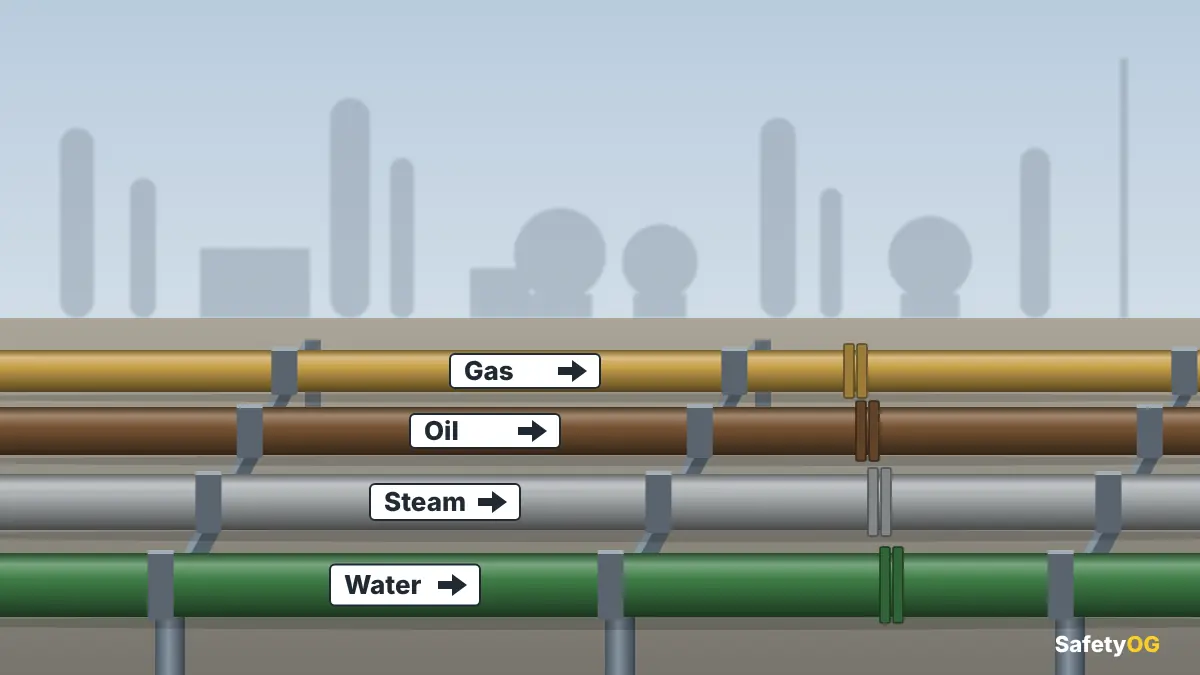
There Is No Single Global Standard
The main schemes you will meet are:
- ASME A13.1 (United States), Scheme for the Identification of Piping Systems. It covers aboveground piping in industrial, commercial and institutional installations, and not electrical conduits (ASME).
- BS 1710 (United Kingdom), which uses BS 4800 colour references and is widely used in the UK and many countries influenced by British practice.
- ISO 14726, a two-colour banded system for ships and marine piping. A newer standard, ISO 20560-1:2020, sets out safety information for overground piping systems and drew on national pipe marking standards, but national and company schemes remain in use.
Many oil and gas operators also have their own pipe identification standard, based on one of the above. Contractors who work on several sites must learn each site’s rules. The standards are updated from time to time, so check which edition your site follows.
BS 1710 Basic Identification Colours
In BS 1710, the basic colour shows what the pipe carries. This table shows only the main colours that could be confirmed from published guidance. It is not the full scheme, and the standard has more colours and rules. Check the standard or your site’s specification:
| Contents | Basic colour |
|---|---|
| Water | Green |
| Steam | Silver-grey |
| Oils | Brown |
| Gases | Yellow ochre |
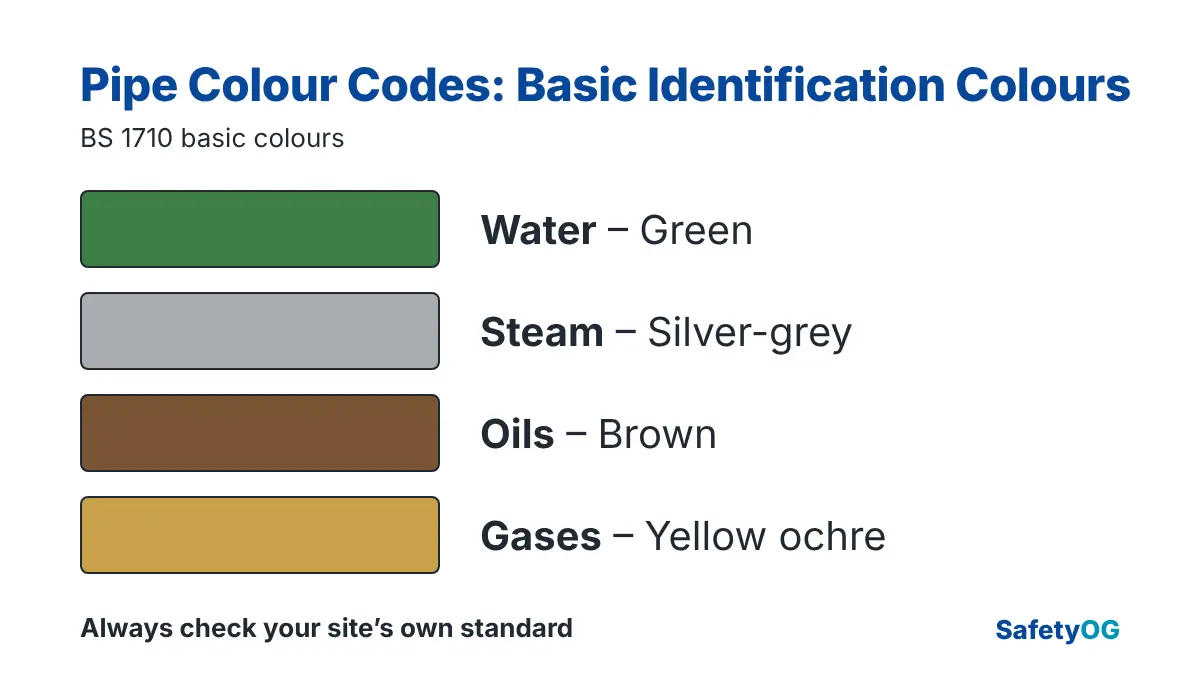
Fire-fighting is shown with the safety colour red. The basic colour is usually applied on both sides of the safety colour band. For example, fire-fighting water is shown as green, red, green (Duralabel – BS 1710 guide). The standard also has colours for other services, such as drainage and electrical. Check the standard or your site’s specification for those.
Fire water lines feed hydrants and deluge systems. See how a fire pump system works.
ASME A13.1 Colours (US)
ASME A13.1 is based on the hazard of the contents. In the 2015 edition, as commonly summarised, the background colours include:
| Contents | Background colour |
|---|---|
| Flammable fluids | Yellow |
| Combustible fluids | Brown |
| Toxic and corrosive fluids | Orange |
| Water | Green |
| Compressed air | Blue |
| Fire-fighting fluids | Red |
| User-defined | Purple, grey, white or black |
Older markings may follow earlier editions, and ASME now lists a newer edition on its website. Because the scheme has changed between editions, check the edition your site uses before relying on a colour.
Under ASME A13.1, a label typically carries the name of the contents in text and a flow direction arrow, so the colour is only part of the message.
Where the Schemes Agree and Where They Do Not
| Colour | BS 1710 | ASME A13.1 (2015 edition) |
|---|---|---|
| Green | Water | Water |
| Red | Fire-fighting | Fire-fighting |
| Brown | Oils | Combustible fluids |
| Yellow | Gases (yellow ochre) | Flammable fluids, including flammable liquids |
Even where the colour matches, the meaning is not always identical. Yellow, for example, means gas in one scheme and flammable material in the other. And the same hazard can have a different colour in a third scheme. That is why your site’s own rules come first.
What the Law Says
Requirements depend on the country and the industry. In the US, OSHA standards mention pipe marking in specific cases. For example, 29 CFR 1910.261 says chlorine, caustic and acid lines must be marked for positive identification, and it refers to the ANSI A13.1 identification scheme (29 CFR 1910.261). State rules, company standards and client specifications often go further. Check the rules that apply where you work.
Colour Is Not Enough: Label, Arrow and Line Number
Never rely on colour alone, for these reasons:
- Paint fades, gets dirty and is sometimes painted over during a maintenance campaign.
- Pipes may be insulated or clad, which hides the colour.
- Colour-blind workers may not tell some colours apart.
- Different schemes use the same colour for different contents.
- Temporary hoses and tie-ins usually have no marking at all.
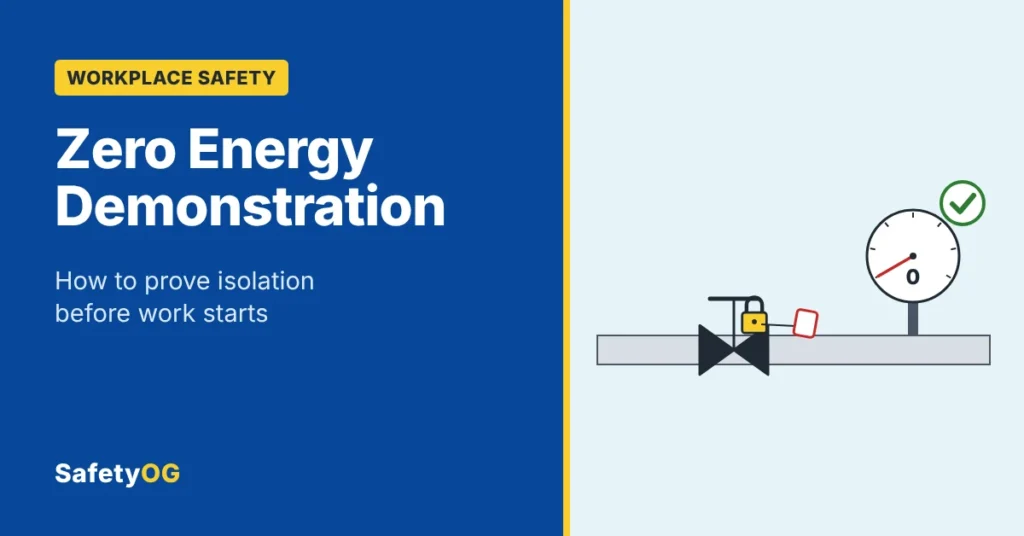
For high-risk work, identification comes from the line number, the P&ID and the isolation certificate, confirmed on site at the break point. Our guide to the zero energy demonstration explains how isolation is proven before a line is opened. The colour is a first clue and a warning sign, and not proof.
Where Markings Are Usually Placed
Standards and site procedures set the exact rules, but markings are commonly found:
- near valves and at branches
- on both sides of walls, floors and platforms the pipe passes through
- where the pipe changes direction
- near equipment connections
- along straight runs at regular intervals
Labels must be readable from the normal direction of approach, and the flow arrow must be visible. If you cannot read a label, treat the line as unknown until it is identified.
What Goes Wrong in Practice
Illustrative example: the repainted line. During a shutdown, a contractor repaints a section of pipe rack in a single colour to freshen it up. Weeks later, an operator relies on the old colour to find the fire water isolation valve and loses time. Marking should be restored after any repainting, and checked.
Illustrative example: the colour from the last site. A fitter moves from a UK plant to a US-based facility. He assumes yellow means gas, because that was the rule at his old site. Here, yellow means flammable fluid, including liquids. The mismatch is caught in the toolbox talk, because the supervisor reviewed the site’s marking scheme with the crew.
Illustrative example: the unlabelled hose. A temporary hose is run across a walkway for a cleaning job with no label or tag. Another crew connects a tool to it, assuming it is plant air. A tag stating the contents, pressure and owner on every temporary hose prevents this.
What an HSE Officer Can Do
- Find out which pipe marking standard and edition your site uses, and keep a copy of the colour table at the induction room and the permit office
- Include the marking scheme in the induction for contractors and visitors. See our guide to the general safety induction
- Inspect marking during site walk-arounds, and report faded, missing or wrong labels for correction
- Make sure line numbers, not colours, are used on permits and isolation certificates
- Check that temporary hoses and tie-ins are tagged
- Raise colour conflicts when contractors from other countries join the site
Common Mistakes and How to Fix Them
| Mistake | Fix |
|---|---|
| Identifying a line by colour alone | Confirm with the label, line number, P&ID and isolation certificate |
| Assuming colours mean the same everywhere | Learn the scheme and edition used on your site |
| Copying colour charts from social media | Use the standard or the site’s own specification |
| Leaving faded or missing labels | Report and renew them as part of inspections |
| Painting over markings during maintenance | Restore the colour and label, and verify afterwards |
| Not tagging temporary hoses | Tag contents, pressure and owner on every temporary line |
Interview Questions on This Topic
Why are pipes colour-coded? To help people recognise what a pipe carries and how hazardous it is, to prevent isolating or opening the wrong line, and to support emergency response.
Is there a single international pipe colour code? No. The US uses ASME A13.1, the UK uses BS 1710, and ships use ISO 14726. Many companies have their own standard, so you must learn the scheme used at each site.
What does green mean on a pipe? In both BS 1710 and ASME A13.1, green is used for water. For fire water, other markings such as red bands or labels may also appear, depending on the scheme.
Can you rely on pipe colour before opening a line? No. Colour is a clue only. You must confirm the line with its label and number, the permit, the P&ID and the isolation certificate, and prove isolation before breaking containment.
FAQ
What is the pipe colour code for fire-fighting water? Red is the colour used for fire-fighting in both BS 1710 and ASME A13.1. In BS 1710, fire-fighting water is shown with green and red bands together, and in ASME A13.1, the fire-fighting label background is red.
What colour is a gas pipe? It depends on the scheme. In BS 1710, gases use yellow ochre. In ASME A13.1, yellow is for flammable fluids and blue is for compressed air. Check your site’s standard and the label.
What does ASME A13.1 cover? ASME A13.1, Scheme for the Identification of Piping Systems, provides a common system for identifying the contents of aboveground piping in industrial, commercial and institutional installations. It does not cover electrical conduits.
Is pipe colour coding required by law? It depends on the country and industry. In the US, OSHA standards require pipe marking only in specific cases, such as chlorine, caustic and acid lines under 29 CFR 1910.261. Company standards, client specifications and local law often require it, so check what applies where you work.
Why shouldn’t I rely on colour alone? Because paint fades, pipes are repainted or insulated, schemes differ between countries, and some people cannot distinguish certain colours. Always confirm with the label, flow arrow, line number and isolation records before working on a line.
Conclusion
Pipe colour codes are a quick way to read a plant, but only if you know which scheme your site uses, and only as a first clue. Learn your site’s colour table, read the label, follow the line number on the permit, and prove isolation before you break a line. Next, read our guides to industry hazards, fire safety and process safety vs occupational safety, and practise with our oil and gas interview questions and answers.
Related reading
- Top five fire fighting equipment
- H2S safety training for oil and gas
- Risk assessment and the hierarchy of control
Last reviewed: November 2026. General guidance only. Follow your site’s pipe identification standard, procedures and local law.
About the author

Adil Ahmed — HSE Officer. 4+ years across oil and gas EPC projects, drilling rig operations, refinery operations, brownfield tank farm expansion and shutdown/turnaround (TAR) work in the Middle East and South Asia, covering permit to work, JSA/JHA, risk assessment, confined space entry, lifting operations and hot work.
Qualifications: NEBOSH International General Certificate in Occupational Health and Safety · IOSH Managing Safely
See project experience → · Follow SafetyOG on LinkedIn
General guidance only. Standards and requirements vary by company, country and permit system — always follow your own site’s approved procedure.