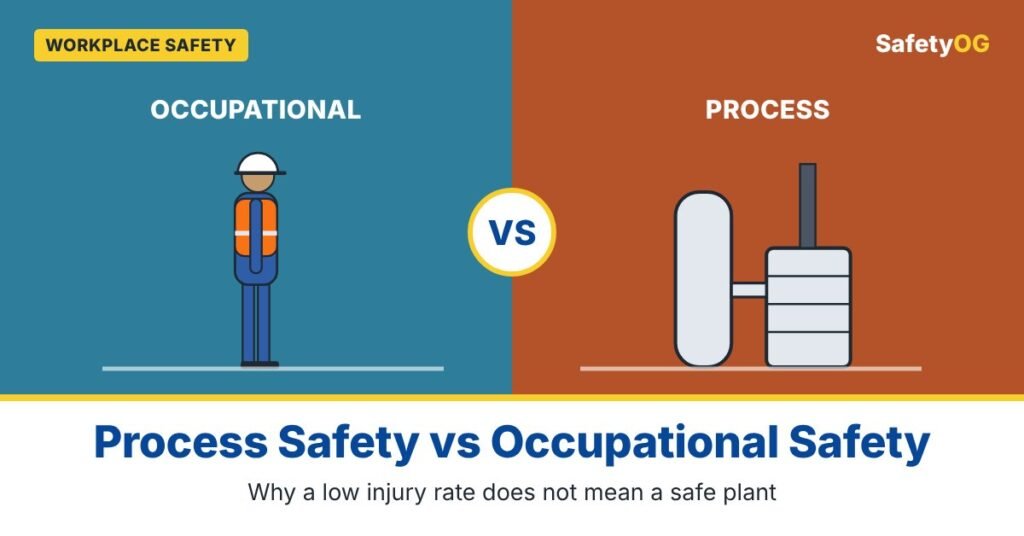
A refinery can go a whole year without a single lost-time injury and still be one leaking flange away from a disaster. That sounds wrong, but it is the central lesson investigators drew from the 2005 Texas City refinery explosion, covered below. The reason is that there are two different kinds of safety on an oil and gas site, and they need different controls and different measures.
This guide explains process safety vs occupational safety in plain terms: what each one covers, how they differ, why a good injury record does not prove a plant is safe, and the measures used for each. It is written for new HSE officers, supervisors and anyone preparing for an oil and gas safety interview, where this question comes up often.
Key takeaways
- Occupational safety protects individual workers from everyday injuries such as slips, trips, falls, cuts and manual handling injuries.
- Process safety keeps hazardous materials and energy inside the equipment, so that fires, explosions and toxic releases do not happen.
- Occupational incidents are usually frequent and lower in severity. Process incidents are rarer but can kill many people at once.
- Injury rates such as LTI and TRIR measure occupational safety. They do not show how well major hazards are controlled.
- A strong site manages both, with separate controls and separate measures.
What Is Occupational Safety?
Occupational safety, also called personal safety, is about preventing injuries to individual people while they work. The focus is the worker and the task.
Typical hazards:
- slips, trips and falls on the same level
- falls from height
- cuts, crushed hands and pinch points
- manual handling and lifting injuries
- struck-by and dropped objects
- driving and vehicle incidents
Typical controls: risk assessments and JSAs, PPE, training, tool inspections, housekeeping, toolbox talks and stop work authority. For more on these, see our guides to basic occupational safety, hand safety, line of fire and dropped objects and risk assessment and the hierarchy of control.
What Is Process Safety?
Process safety is about keeping the process under control. Oil and gas plants hold large amounts of flammable and toxic material under pressure and at high temperature. Process safety aims to prevent that material, or the energy in it, from escaping in an uncontrolled way.
The event that process safety is built to prevent is a loss of primary containment (LOPC). The API recommended practice RP 754 defines it as an unplanned or uncontrolled release of any material from primary containment, meaning the tanks, vessels, pipes and other equipment designed to hold it (API – process safety event reporting guide).
Typical hazards:
- hydrocarbon leaks that can ignite
- fires and explosions, including vapour cloud explosions
- toxic releases such as H₂S. See our H₂S safety training guide.
- overpressure and vessel or pipe failure
- runaway reactions in some process units
Typical controls (often called barriers):
- sound design and the right materials for the service
- relief valves, safety instrumented systems, gas and fire detection and alarms
- inspection and maintenance of equipment, including corrosion monitoring
- operating procedures and trained, competent operators
- management of change, so that modifications to plant, process or organisation are risk assessed before they happen
- permit to work and isolation, which protect people and the process during maintenance. See our permit to work guide.
- emergency response planning
Many countries regulate process safety through specific laws, for example the OSHA Process Safety Management standard in the US, and major hazard rules such as COMAH in Great Britain. Which rules apply depends on the country, the site and the quantities of hazardous material held, so check your own.
Process Safety vs Occupational Safety: The Differences
| Occupational safety | Process safety | |
|---|---|---|
| Focus | The individual worker and the task | The plant, the process and the hazardous material in it |
| Typical hazards | Slips, trips, falls, cuts, manual handling | Leaks, fires, explosions, toxic releases |
| Typical frequency and severity | More frequent, usually lower severity | Rare, but potentially catastrophic |
| Who can be affected | Usually the person doing the task, or someone nearby | Many people on site, and sometimes the public and the environment |
| Main controls | PPE, training, JSAs, safe behaviour, tool and equipment checks | Design, barriers, inspection and maintenance, procedures, management of change |
| Typical measures | LTI, TRIR, first aid and near-miss counts | Loss of primary containment events, barrier health, overdue safety-critical maintenance |
| Who owns it | Everyone, led by line supervisors | Management, engineering, operations and maintenance, with HSE support |
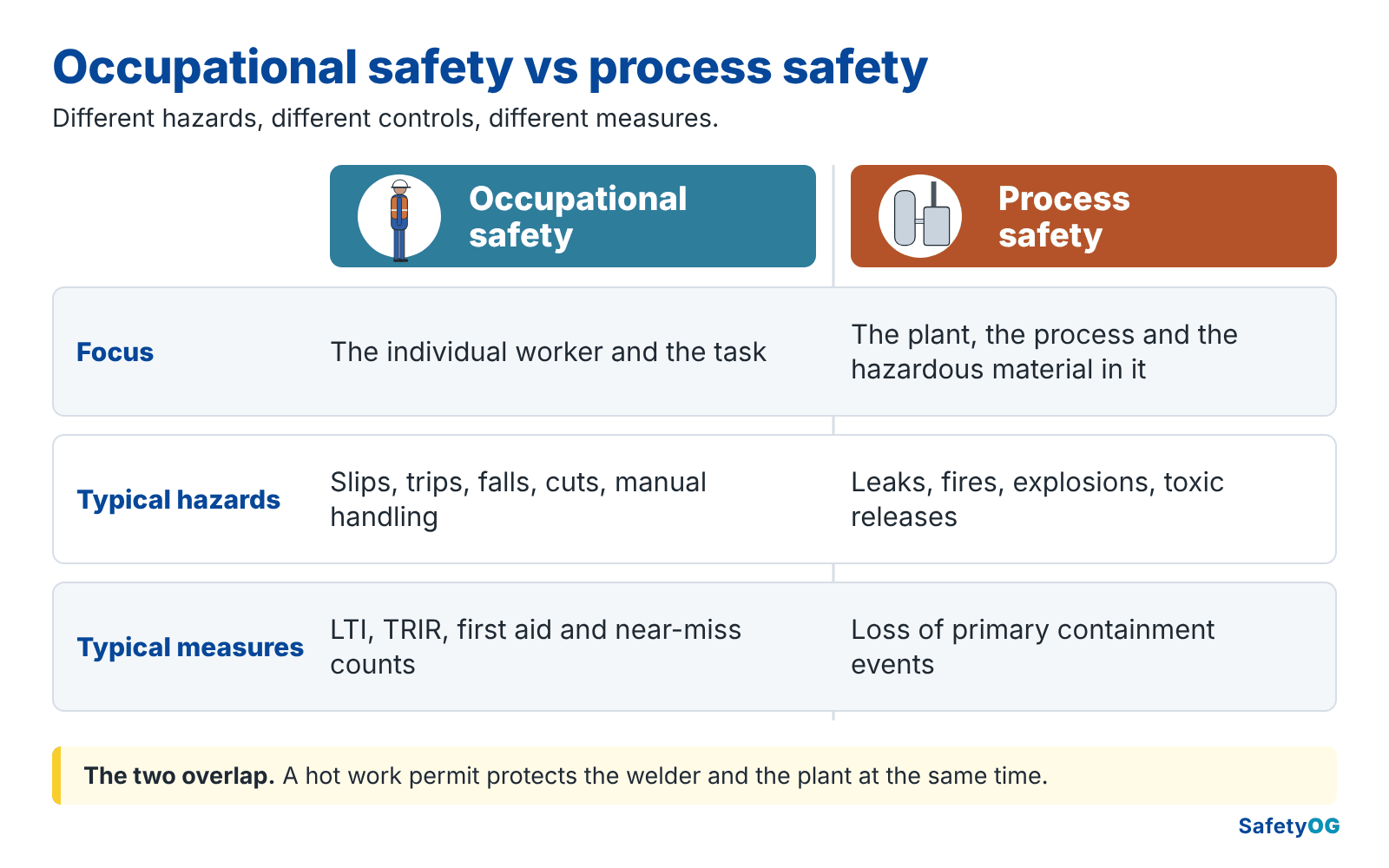
The two overlap. A worker burned in a flash fire is both an injury and a process safety event. A hot work permit protects the welder and the plant at the same time. The point is not that one matters more. They need different attention because they fail in different ways.
Why a Low Injury Rate Does Not Mean a Safe Plant
Injury rates are easy to count, so companies track them closely. LTI (lost time injury) and TRIR (total recordable incident rate) are useful for personal safety. But because major process accidents are rare, a site can have an excellent injury record while serious process hazards go unmanaged.
BP Texas City, 2005. On 23 March 2005, an explosion and fire at the BP refinery in Texas City, Texas, killed 15 people and injured 180 others. The US Chemical Safety Board (CSB) found organisational and safety deficiencies at all levels of the BP Corporation (CSB). An independent review panel led by James Baker later found that BP had relied on personal injury rates as its main indicator of process safety performance, which gave management a false sense that process risks were being managed (US DOE Safety Advisory 2007-02).
Piper Alpha, 1988. The Piper Alpha disaster in the North Sea killed 167 people (FABIG). Investigations found that the permit to work system was often not implemented according to procedure, and that supervisors often left permits on the control room desk at the end of a shift instead of returning them in person. These are process safety management failures, not personal safety failures.
The lesson is simple: personal injury numbers tell you how well people are protected from everyday hazards, not whether the plant’s major hazard barriers are working.
How Each Is Measured
Occupational safety measures
- LTI: a work injury after which the person cannot return to work on the next scheduled shift, or longer, as your company defines it
- LTIFR / TRIR: injury counts converted to a rate, using hours worked. The base differs: the US OSHA formula uses 200,000 hours (OSHA), while IOGP reports injury rates per million hours worked. Always check which your company uses
- First aid cases, near misses and unsafe act or condition reports
Process safety measures
The API RP 754 standard groups process safety events into Tier 1 (the more severe) and Tier 2, based on consequences such as injury, fire damage and the quantity released. UK HSE guidance HSG254 offers a step-by-step approach to developing process safety indicators.
Common examples used on sites:
- LOPC events by size and material
- Overdue safety-critical maintenance and inspections, such as relief valves, alarms and gas detectors
- Safety-critical alarms or trips that are bypassed or inhibited
- Management of change actions overdue
- Emergency drills completed and actions closed
- Operating limit excursions, such as pressure or temperature outside safe limits
The exact set differs by company. What matters is that each measure tells you something about whether a barrier is working before something is released.
What Goes Wrong in Practice
Illustrative example: the clean record. A gas plant celebrates 1,000 days without a lost-time injury. At the same time, a relief valve test is six months overdue, a gas detector is bypassed on a compressor and nobody has reviewed the effect of a recent pipework modification. The injury statistics look excellent while the major hazard barriers are weakening.
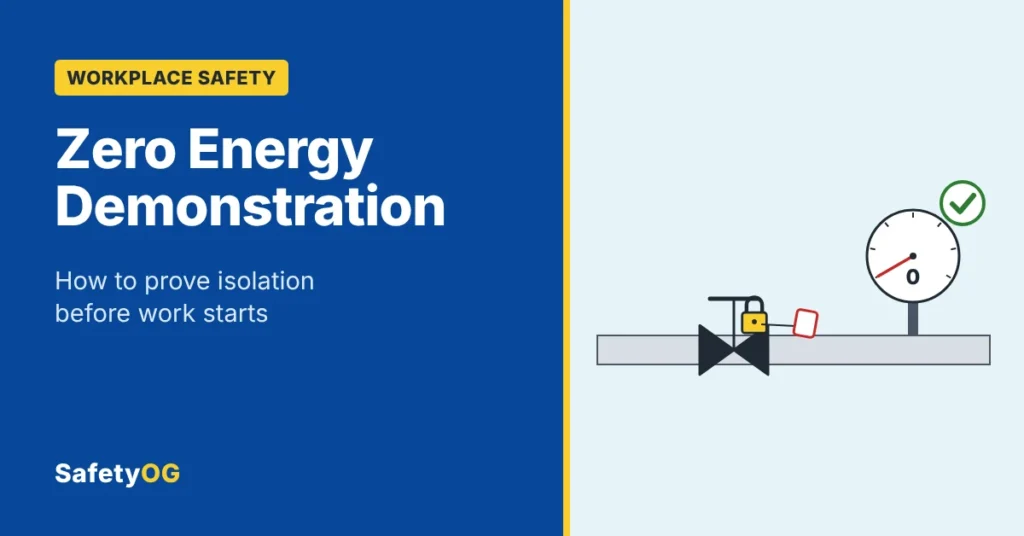
Illustrative example: two crews, two kinds of risk. One crew wears the right gloves, tethers its tools and keeps the work area tidy, which is good occupational safety. Beside them, a line is opened for maintenance without proper isolation and without proving zero energy. The first crew’s discipline does nothing to protect against a release from the second job. See our guide to the zero energy demonstration for how isolation is proven.
Illustrative example: the unreported change. An operator changes a control setting to keep production running during a busy shift. There is no review, no approval and no record. Management of change exists to catch exactly this.
Interview Questions on This Topic
What is the difference between process safety and occupational safety? Occupational safety protects individual workers from everyday injuries such as slips, cuts and manual handling. Process safety prevents loss of containment of hazardous materials, which could cause fires, explosions or toxic releases. They need different controls and different measures.
Why is a low LTI rate not enough? Because LTI counts injuries, and major process accidents are rare. A site can have few injuries and still have weak barriers, as the Texas City investigations showed. Process safety needs its own indicators, such as loss of containment events and the health of safety-critical equipment.
What is loss of primary containment? An unplanned or uncontrolled release of material from the equipment designed to hold it, such as a tank, vessel or pipe. It is the event process safety is designed to prevent.
Give an example of a process safety barrier. A pressure relief valve, a safety instrumented system that trips on high pressure, a gas detector linked to an alarm, or a proven isolation during maintenance.
Is process safety only the engineers’ job? No. Engineers design barriers, but operators run the plant, maintenance teams keep the barriers working and supervisors follow procedures and permits. Everyone has a role, and HSE officers help to monitor and challenge.
What an HSE Officer Can Do
- Look at both kinds of data: injury statistics and the state of safety-critical equipment
- Check that overdue inspections, bypassed alarms and open management of change items are reported and followed up
- Make sure permits, isolations and handovers are done properly, because they protect both people and the process
- Report near misses involving small leaks and alarms, not only injuries
- Ask what a barrier is meant to prevent, and whether it is working today
Common Mistakes and How to Fix Them
| Mistake | Fix |
|---|---|
| Using injury rates to judge overall safety | Track process safety indicators as well |
| Treating small leaks as housekeeping | Report and investigate them as loss of containment events |
| Bypassing alarms or trips without approval | Follow the bypass procedure, with risk assessment and time limits |
| Changing plant or procedures informally | Use management of change every time |
| Leaving safety-critical maintenance overdue | Track it, report it and give it priority |
| Believing process safety is only for engineers | Give operators and maintenance clear roles and training |
FAQ
What is the difference between process safety and occupational safety? Occupational safety focuses on protecting individual workers from injuries during everyday tasks. Process safety focuses on preventing the uncontrolled release of hazardous materials and energy from the plant, which could cause fires, explosions or toxic releases. Both are needed on an oil and gas site.
What is an example of a process safety incident? A leak of flammable gas from a flange, a vessel overpressure, a fire in a process unit, or a toxic gas release such as H₂S. An unplanned release from equipment designed to hold the material is called a loss of primary containment.
What does LTI mean? LTI stands for lost time injury. It is a work injury that stops the person from working on a later shift, though exact definitions differ between companies and countries. LTI and TRIR measure personal safety, not process safety.
Why did a low injury rate not prevent the Texas City explosion? The 2005 explosion killed 15 people. An independent panel found that BP relied on personal injury rates as its main process safety indicator, which gave a false sense that process risks were controlled. Injury rates and process safety need separate measures.
What are Tier 1 and Tier 2 process safety events? They are categories in the API RP 754 standard for reporting process safety events. Tier 1 events are the more severe, based on consequences such as serious injury, fire damage or the amount released. Tier 2 events are less severe. Your company will use the thresholds in its own procedures.
Conclusion
Occupational safety keeps people from getting hurt doing their jobs. Process safety keeps the plant from hurting everyone. A site needs both, and a good injury record is never proof of the second. If you are an HSE officer, ask what your site measures for process safety and whether those barriers are working today. Then read our guides to industry hazards and fire safety, and practise with our oil and gas interview questions and answers.
Related reading
- How a fire pump system works
- HSE officer interview questions, Part 3
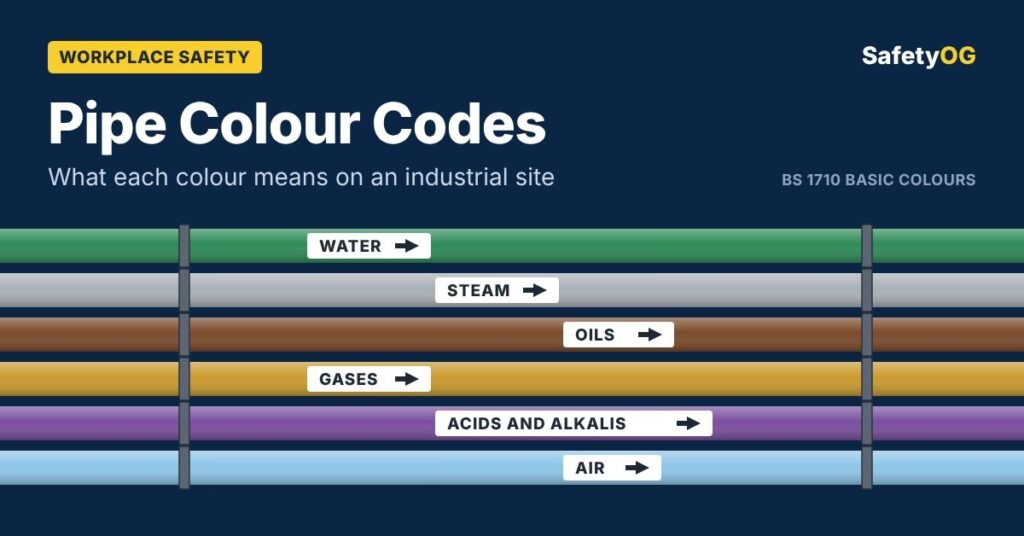
- What pipe colour codes mean on site
Last reviewed: November 2026. General guidance only. Follow your company’s HSE management system, process safety procedures and local law.
About the author

Adil Ahmed — HSE Officer. 4+ years across oil and gas EPC projects, drilling rig operations, refinery operations, brownfield tank farm expansion and shutdown/turnaround (TAR) work in the Middle East and South Asia, covering permit to work, JSA/JHA, risk assessment, confined space entry, lifting operations and hot work.
Qualifications: NEBOSH International General Certificate in Occupational Health and Safety · IOSH Managing Safely
See project experience → · Follow SafetyOG on LinkedIn
General guidance only. Standards and requirements vary by company, country and permit system — always follow your own site’s approved procedure.