A fire water ring main, a row of hydrants and a deluge system are only as good as the pressure behind them. On most plants that pressure comes from a fire pump house that nobody visits until something goes wrong. If the pump fails to start on the day of a fire, every hydrant and monitor downstream is just pipework.
This guide explains how a fire pump system works: what each part does, what makes the pump start, the difference between the jockey pump and the main fire pump, and the routine checks that keep the system ready. It is written for HSE officers, fire watchers, supervisors and anyone preparing for a safety interview. It explains principles only. Operating and testing a fire pump is a job for trained, authorised people.
Key takeaways
- A fire pump raises the pressure of a water supply that is not strong enough on its own for the fire protection system it feeds.
- A small jockey pump keeps the system topped up. The main fire pump starts automatically when system pressure drops, as it does when a hydrant or sprinkler opens.
- Fire pumps are driven by an electric motor or a diesel engine. Many sites have both, so one can cover for the other.
- In the US, NFPA 20 covers installation and NFPA 25 covers inspection, testing and maintenance. Other countries and companies use their own standards.
- A fire pump that is switched off, valved shut or left out of automatic will not help anyone. Routine checks exist to catch exactly that.
What Does a Fire Pump Do?
The US National Fire Protection Association (NFPA) describes fire pumps as an essential part of many water-based fire protection systems, used to increase the pressure of a water source when that source is not adequate for the system it supplies (NFPA – fire pump types).
Two points follow from that:
- A fire pump does not make water. It needs a reliable supply, such as a fire water tank, a reservoir or the sea, and it adds pressure to it.
- It serves the whole fire water system. On an oil and gas site this usually means the fire water main, hydrants, monitors, hose reels, and fixed systems such as sprinklers and deluge.
For the equipment at the other end of the pipe, see our guide to the top 5 fire fighting equipment.
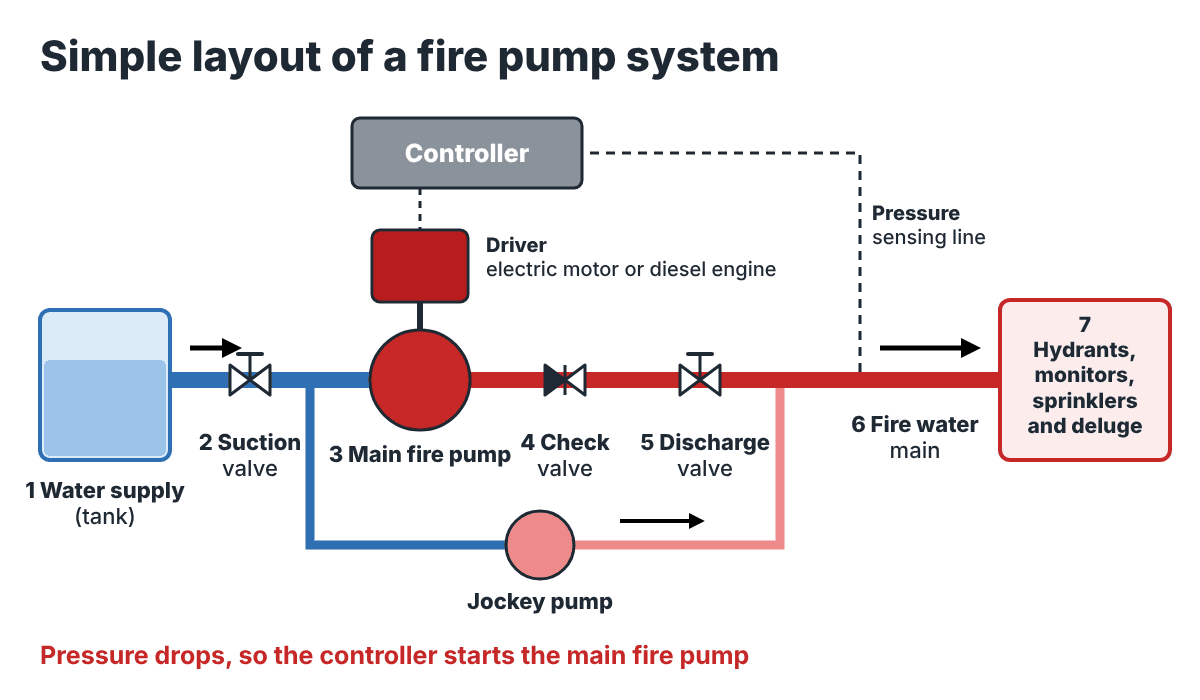
The Main Parts of a Fire Pump System
| Part | What it does |
|---|---|
| Water supply | Tank, reservoir or other source that feeds the pump |
| Suction valve and piping | Brings water to the pump. The valve must stay fully open |
| Main fire pump | Raises the water pressure to what the system needs |
| Driver | The electric motor or diesel engine that turns the pump |
| Controller | The panel that monitors pressure, starts the pump and gives alarms |
| Pressure sensing line | Small line that lets the controller read system pressure |
| Jockey pump | Small pressure maintenance pump that keeps the system topped up |
| Check valve | Stops water flowing backwards through the pump |
| Discharge valve | Connects the pump to the fire water main. It must stay fully open |
| Relief valve | Releases a small flow or excess pressure to protect the pump and piping |
| Test connection | Lets the pump be flow tested without sending water into the plant |
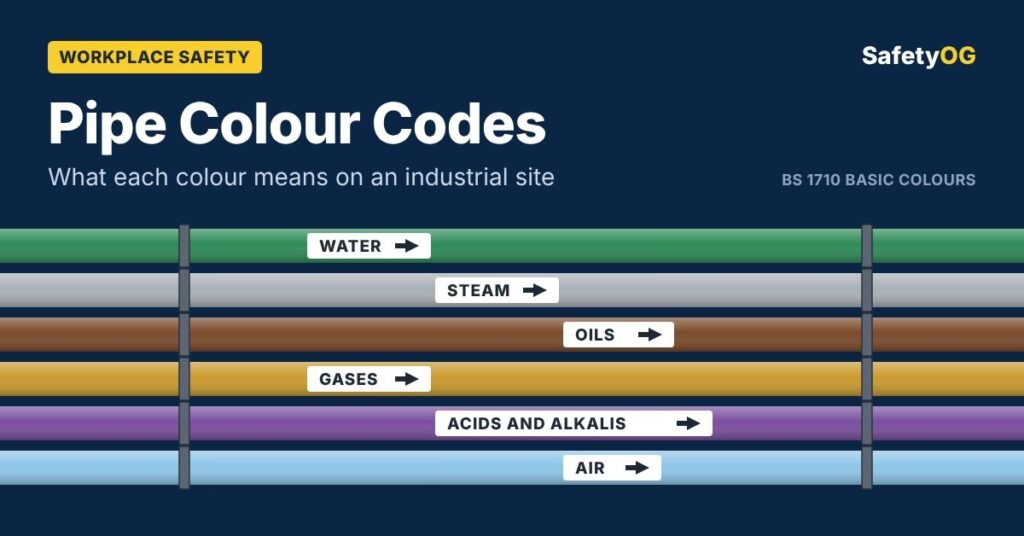
Layouts differ from site to site. Use your own site’s fire water drawing to learn which valve is which. Fire water lines are normally marked in red, as our guide to pipe colour codes explains.
Jockey Pump vs Main Fire Pump
| Jockey pump | Main fire pump | |
|---|---|---|
| Purpose | Keeps the system at its normal pressure | Supplies the water needed to fight a fire |
| Size | Small | Large |
| When it runs | Briefly, to make up for small pressure losses | When there is a real demand, such as an open hydrant or sprinkler |
| If it runs often | Suggests a leak or a passing valve somewhere in the system | Should be investigated and reported |
NFPA calls the jockey pump a pressure maintenance pump. Without it, small leaks would let the pressure fall until the main fire pump started, again and again, for no reason.
Types of Fire Pump and Driver
According to NFPA, there are two main categories of fire pump: positive displacement and centrifugal. Centrifugal pumps are the most common and are used with most systems. Positive displacement pumps have a specialised use, mainly with water mist and foam-water systems.
Common centrifugal arrangements include:
- Horizontal split-case pumps: the casing can be opened for maintenance, and they can be used with electric or diesel drivers.
- Vertical turbine pumps: NFPA notes that this is the only type NFPA 20 allows to take water under a lift condition, for example from a river or a tank below ground level.
- In-line and end suction pumps: more compact, for smaller capacities.
Drivers. An electric motor depends on the power supply. A diesel engine has its own fuel and starting batteries, so it can run during a power failure. Many industrial sites install both, or more than one pump, so that the loss of one does not leave the site without fire water. The arrangement required is set by the design standard, the fire risk assessment and, often, the insurer or local authority.
How a Fire Pump Starts: Step by Step
- Normal condition. The fire water system is full and under pressure. The jockey pump cuts in now and then to hold that pressure.
- Demand. A sprinkler operates, a deluge valve opens or someone opens a hydrant. Water leaves the system faster than the jockey pump can replace it.
- Pressure drop. The controller reads the falling pressure through the sensing line, using a pressure switch or pressure transducer.
- Automatic start. At its set pressure, the controller starts the main fire pump. Set pressures are fixed by the system design and are not adjusted by operators.
- Pump running. The pump delivers water to the fire water main, and the controller gives a “pump running” signal, usually to the control room or fire panel.
- Second pump. Where there is a standby pump, it is usually set to start if the pressure keeps falling or the first pump fails to start.
- Stopping. Depending on the controller, the pump keeps running until an authorised person stops it at the controller, or it stops automatically after a set time. Follow your site’s procedure.
If you hear a fire pump running or see a “pump running” alarm, treat it as real until proven otherwise. Our guide to fire safety covers what to do in a fire emergency.
Keeping the Pump Ready: Inspection and Testing
A fire pump can sit unused for years, so its reliability depends on routine inspection, testing and maintenance. In the US these are set out in NFPA 25. The points below are taken from NFPA’s own guidance on that standard. Your site may follow a different standard or a company procedure, and requirements change between editions, so use the frequencies in your own procedure.
Weekly visual inspection
NFPA describes an inspection as a visual check that the system appears to be in operating condition and free of physical damage. For the pump room and pump system, the weekly items include (NFPA – weekly inspections of electric fire pumps):
- pump room heat is adequate, not less than 40 °F (4 °C)
- no excessive water on the floor, and piping free of leaks
- coupling guard in place
- suction, discharge and bypass valves fully open
- suction pressure gauge reading within the acceptable range
- suction reservoir at the required water level
- controller “power on” pilot light illuminated
- power available to the jockey pump
No-flow (churn) test
In a no-flow test, the pump is started and run without sending water into the system, to confirm that it starts automatically and does not overheat. According to NFPA (NFPA – weekly or monthly no-flow tests of fire pumps):
- Diesel fire pumps are generally tested weekly and run for a minimum of 30 minutes.
- Most electric fire pumps can be tested monthly and are run for a minimum of 10 minutes. Some electric pumps, such as vertical turbine pumps and those taking suction from ground-level tanks, need weekly tests unless a redundant pump is provided.
- The pump is started automatically, by drawing water from the sensing line to simulate a pressure drop, and not by pressing the start button on the controller.
- Qualified personnel must attend while the pump is running, unless approved automated testing is used.
Annual flow test
NFPA also describes an annual flow test, in which water is actually flowed to verify the complete operating condition of the pump. This is specialist work, done by qualified people under the site’s procedures.
Taking a Fire Pump Out of Service
Sometimes a pump has to be isolated for repair. This removes a safety-critical barrier, so on most sites it is controlled through a permit or a fire system impairment procedure, with the control room informed and extra precautions agreed, such as restricting hot work. The exact process varies by company. See our guide to the permit to work system, and our guide to process safety vs occupational safety for why overdue checks on safety-critical equipment matter.
What Goes Wrong in Practice
Illustrative example: the selector left out of automatic. After a test, the controller is left in “off” instead of “auto”. Nothing looks wrong, and the jockey pump still holds the pressure. Weeks later a hydrant is opened during a drill and the main pump does not start. A sign-off step that confirms the controller is back in automatic would have caught it.
Illustrative example: the closed suction valve. A suction valve is shut for a repair and not reopened. The pump starts on demand but has no water to deliver. Locking fire water valves open, and listing them on the weekly inspection, prevents this.
Illustrative example: the jockey pump that never rests. Operators notice the jockey pump starting every few minutes. It is reported as a nuisance, not a warning. The cause is a leak on a buried fire water main, which is slowly getting worse. A jockey pump that runs often is telling you the system is losing water.
What an HSE Officer Can Do
- Know where the fire pump house is, which pumps are duty and standby, and what the “pump running” alarm means
- Check that inspections and tests are being done and recorded at the frequency your site’s procedure requires
- During walk-arounds, look for the basics: controller power light on, valves open and locked or tagged as required, no leaks, guards in place, access clear
- Make sure any fire pump isolation is covered by the site’s permit or impairment process, and that the control room knows
- Treat an overdue fire pump test like any other overdue safety-critical maintenance, and report it
- Leave operation, testing and adjustment to authorised people
Common Mistakes and How to Fix Them
| Mistake | Fix |
|---|---|
| Leaving the controller out of automatic after a test | Add a sign-off step to confirm the pump is back in automatic |
| Closing fire water valves and forgetting them | Lock valves open, and check them at every inspection |
| Ignoring a jockey pump that runs often | Report it and find the leak |
| Testing by pressing the start button only | Test the automatic start, as the procedure requires |
| Isolating a fire pump without telling anyone | Use the permit or impairment procedure and inform the control room |
| Skipping tests during busy periods | Treat fire pump tests as safety-critical work |
Interview Questions on This Topic
What is the purpose of a fire pump? To increase the pressure of the water supply so that the fire protection system, such as hydrants, monitors, sprinklers and deluge, gets the flow and pressure it needs.
What is a jockey pump? A small pressure maintenance pump that keeps the fire water system at its normal pressure, so that small losses do not start the main fire pump.
What makes a fire pump start? A drop in system pressure. The controller senses it through the sensing line and starts the pump automatically.
Why do many sites have a diesel fire pump as well as an electric one? Because a fire can happen during a power failure. A diesel engine has its own fuel and batteries, so it does not depend on the site’s electrical supply.
FAQ
How does a fire pump system work?
The system is kept full and under pressure by a small jockey pump. When a hydrant, sprinkler or deluge valve opens, the pressure falls. The controller senses this and starts the main fire pump, which delivers water from the supply into the fire water main at the pressure the system needs.
What is the difference between a jockey pump and a fire pump?
A jockey pump is small and only tops up pressure lost through minor leaks. The main fire pump is large and supplies the water needed to fight a fire. If the jockey pump runs often, the system is probably leaking and should be checked.
How often should a fire pump be tested?
It depends on the standard and the site procedure. Under NFPA 25, as NFPA explains, diesel fire pumps are generally no-flow tested weekly and most electric fire pumps monthly, with a flow test each year. Other countries and companies set their own frequencies.
Which standard covers fire pumps?
In the US, NFPA 20 covers the installation of stationary fire pumps, and NFPA 25 covers the inspection, testing and maintenance of water-based fire protection systems. Other countries use their own standards, and many companies and insurers add their own requirements.
Can anyone operate or test a fire pump?
No. NFPA 25 requires inspection, testing and maintenance to be done by qualified people, and sites authorise specific staff for this work. Other workers should know where the pump house is and what the alarms mean, and report anything unusual.
Conclusion
A fire pump system is simple in principle: a jockey pump holds the pressure, and the main pump starts automatically when that pressure drops. What makes it reliable is the dull routine of open valves, a controller in automatic, and tests that are done and recorded. Find out where your site’s fire pump house is and when the pump was last tested. Then read our guides to fire safety and the top 5 fire fighting equipment.
Related reading
- Fire watcher and hole watcher duties
- How to prove zero energy before work
- General safety induction for oil and gas plants
Last reviewed: November 2026. General guidance only. Follow your site’s fire water system procedures, the standard your site applies and local law.
About the author

Adil Ahmed — HSE Officer. 4+ years across oil and gas EPC projects, drilling rig operations, refinery operations, brownfield tank farm expansion and shutdown/turnaround (TAR) work in the Middle East and South Asia, covering permit to work, JSA/JHA, risk assessment, confined space entry, lifting operations and hot work.
Qualifications: NEBOSH International General Certificate in Occupational Health and Safety · IOSH Managing Safely
See project experience → · Follow SafetyOG on LinkedIn
General guidance only. Standards and requirements vary by company, country and permit system — always follow your own site’s approved procedure.