
Many HSE officer interviews have two halves. One tests what you know: hazardous areas, gas testing, isolation, lifting. The other tests what you do when the job, the supervisor and the schedule all push the wrong way. Our three-part series covers the technical half. These HSE officer interview questions and answers cover the second half: the role, judgement and situation questions that come up in most panels, with answers you can adapt to your own experience.
It is written for people applying for HSE officer, safety officer or safety supervisor roles, mainly in oil and gas and similar industrial sites. Expectations vary by company, client and country, so treat the answers as a pattern to adapt, not a script to memorise.
Key takeaways
- Interviewers often use scenario questions to see how you act when a supervisor, client or deadline pushes against safety.
- A good answer says what you would do, why, and who you would involve. A one-line answer, or a list of rules with no action, scores badly.
- Use real examples from your own work. If you have none, say what you were taught or what you would do, and do not invent experience.
- The technical questions on zones, gas testing, isolation, lifting and hot work are in Part 1, Part 2 and Part 3 of our series.
- Permit systems, company rules and legal duties differ from site to site. Say so in your answers, and name the system you have used.
What Interviewers Are Really Testing
A panel rarely tells you what it is scoring, but scenario questions usually come down to three things:
- Judgement. Do you stop a job when you should, and do you know when to escalate instead of handling it alone?
- Systems thinking. When something goes wrong, do you ask why it happened, or only who did it?
- Credibility. Can you say no to a supervisor without starting a fight, and explain a risk to a crew in plain words?
Some interviews are mostly technical and some are mostly behavioural. Prepare for both.
How to Structure Your Answers
| Question type | What it tests | A simple structure |
|---|---|---|
| “Tell me about yourself” | Fit and honesty | Your role, the work you did, one result, why this job |
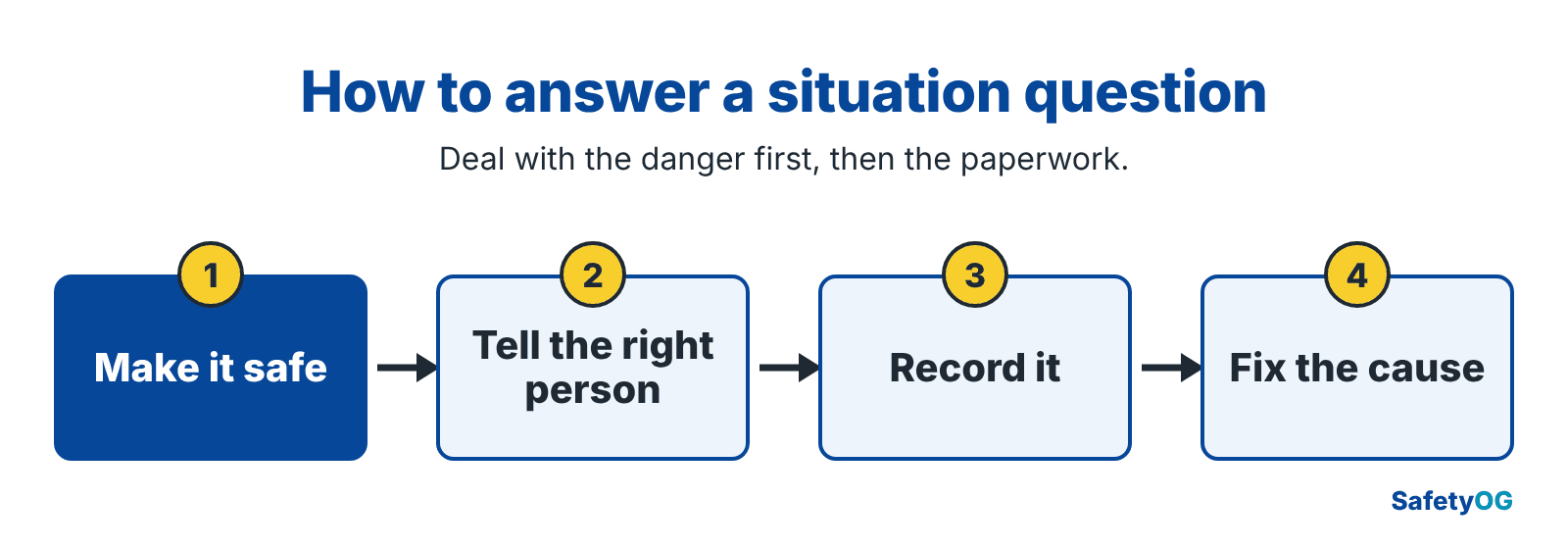
| “What would you do if…” | Judgement | Make it safe, tell the right person, record it, fix the cause |
| “What is…” | Knowledge | Definition, why it matters, a short site example |
For situation questions, the order matters. Interviewers want to hear that you deal with the immediate danger first, then involve the right people, then record what happened, and then look at the cause. An answer that jumps straight to a report form, while someone is still at risk, sounds like a person who has read the procedure but not stood on the site.
Role and Background Questions
Tell me about yourself.
Keep it to four or five sentences and put them in this order: the work you do now or did last, the type of site and jobs, the daily tasks that show HSE experience (permit checks, JSA reviews, site walks, toolbox talks), the qualifications you actually hold, and why you applied for this job.
Example wording (adapt to your own record): “I work as an HSE officer on shutdown jobs, where my days are permit checks, site walks and toolbox talks. I hold a NEBOSH certificate and have worked on both maintenance and construction scopes. I applied here because your site runs permit-controlled work every day, and that is the work I want to get better at.”
Avoid reading out your CV, and never list a qualification you do not hold. Panels check.
Why did you choose HSE as a career?
Give a true reason, and keep it specific. A particular job, an incident you saw, or a supervisor who taught you something is more believable than “I want to keep people safe”, which is what most candidates say. If your route into HSE was through another trade or department, say so. It is a strength, because you have seen how the work is actually done.
What does an HSE officer do on a normal day?
Describe the real routine: checking that permits and JSAs match the work, walking the site and talking to workers, spotting unsafe conditions and acts, running or supporting toolbox talks, following up open actions, and reporting. Add that the day changes with the jobs on site. The exact duties vary by company, so say what you have done rather than reciting a job description.
Who is responsible for safety on site?
Everyone, but in different ways. Line management and supervisors are responsible for running their work safely. Workers are responsible for following the controls and speaking up. The HSE officer advises, checks, supports and, where the company allows it, can stop work. A weak answer says “the HSE officer is responsible for safety”, which suggests you would take on a job that belongs to the line. Legal duties differ by country, so avoid quoting a law you are not sure of.
Stop Work and Pressure Questions
These are the questions most likely to decide the interview.
What is stop work authority, and when would you use it?
Many companies give every worker the authority, and often the duty, to stop work they believe is unsafe, without fear of blame. Check your own company’s policy, because the wording differs.
You would use it when someone is in immediate danger, when conditions on the ground do not match the permit or risk assessment, or when a control that the job depends on is missing or not working. Industry guidance points the same way. IOGP, the oil and gas industry association, says in its Life-Saving Rules guidance that if a rule cannot be followed, the task should not start, and if this becomes clear during the task, work should stop and the supervisor should be called before continuing.
Then explain how you do it: ask for the work to stop, make the situation safe, explain why in plain words, tell the supervisor or permit issuer, and agree what has to change before work restarts. A weak answer is “I would report it to my manager”, while the work carries on.
A supervisor asks you to sign off a permit now and finish the checks later. What do you do?
You do not sign it. Say that out loud first, then explain how you would handle it.
- Tell the supervisor which check is missing, and why it matters for this job.
- Offer to complete it quickly, with them, so the delay is as short as possible.
- If they still insist, take it to the permit issuer or your HSE manager.
- Record what happened, according to your site’s system.
Illustrative scenario (not a real case): A crew wants to restart after a break using the morning’s gas test. Your site’s permit says a new test is needed after a break in work. The supervisor says the reading was fine and the job is already late.
A weak answer is “I would let them go and test later”. A better answer is: “I would not let the work restart. I would tell the supervisor that the permit needs a new gas test, ask the gas tester to do it now, and escalate to the permit issuer if I was pressed. I would note it in my report.” Whether a new test is needed after a break depends on your site’s permit and procedure, so state it as your site’s rule, not as a universal one.
You see a contractor working at height without a harness. What do you do?
Ask the person to stop and get them to a safe position first, calmly and without startling them. Then talk to them away from the crew, and find out why. Was a harness not issued, was there no anchor point, or was time the problem? Tell the contractor’s supervisor and report it through the site system. Then check whether others on the same job have the same problem. This is the answer that shows you look for the cause and not only for someone to blame.
The client’s representative says your recommendation is unnecessary. What do you do?
Do not argue about opinions. Point to the permit conditions, the risk assessment or the procedure, and explain the hazard in plain words. If it is a matter of immediate danger, work stops. If it is a disagreement about a control that is not immediately dangerous, ask for the decision to be recorded and take it to your own manager. Say that you would stay polite and stay firm. Panels like candidates who can do both.
Incident, Near Miss and Reporting Questions
What is a near miss, and why should it be reported?
A near miss is an event that could have caused injury or damage but did not, often by luck. Reporting matters because near misses usually have the same causes as injuries and show weak points while there is still time to fix them. OSHA, the US occupational safety regulator, encourages employers to investigate close calls as well as incidents that cause injury.
How do you investigate an incident?
Describe a simple sequence:
- Make the area safe and look after anyone injured.
- Preserve the scene and collect facts: photos, statements, the permit, the JSA, training and inspection records.
- Find the immediate cause, the thing that directly led to the event.
- Keep asking why, often called the 5 whys, to reach the underlying causes, such as pressure on the schedule, a missing control or unclear responsibility.
- Agree corrective actions with an owner and a date for each.
- Share the lessons with the people who do the work.
OSHA says investigations should aim to find hazards and gaps in the safety programme, and that stopping at an immediate cause, such as a skipped procedure, can be misleading. Say that your aim is to find the cause, not to blame a worker.
Workers on your site do not report near misses. What do you do?
First find out why. Common reasons are fear of blame, long forms, or a belief that nothing happens after a report. Then act on what you find: make reporting quick, thank people who report, tell them what was done, and talk about real reports at toolbox talks without naming anyone. A site where reports lead to visible action gets more of them.
The same type of incident keeps happening. Why might that be?
The usual reasons are that actions are closed on paper but not on site, that the fix was to retrain the worker and not to change the task or equipment, and that nobody checked later whether the fix worked. Say that you would review the earlier actions, look for the shared underlying cause, and follow up on site.
Inspections, Observations and Toolbox Talks
How do you carry out a site inspection?
Prepare first: know which jobs are running, which permits are open and what was found last time. Then walk the site, watch the work as well as the housekeeping, and talk to the people doing it. Record findings with a photo and a location, rank them by risk, and agree an owner and a date for each. Go back and check that they are closed. The answer should show that an inspection is a conversation on site, not only a checklist.
What is the difference between an inspection and an audit?
An inspection looks at conditions and behaviour at the workplace, usually on a regular basis. An audit checks a system, such as the permit system or contractor management, against set criteria, such as the company’s procedures or a standard, and looks at evidence that the system is followed. Many companies run both, and the details vary.
How do you run an effective toolbox talk?
Keep it short, about the job being done that day, and about the hazards and controls the crew will actually meet. Ask questions and let the crew add their own experience. Record who attended. Do not read a sheet aloud for the sake of it. Strong answers also mention using a recent near miss from the same site.
Permits, Contractors and Emergencies
What do you check at the job site before work starts under a permit?
Check that the permit matches the job and the location and is valid and signed, that the JSA or risk assessment has been briefed to the crew, that isolations are in place, and that the gas test and any other required tests are done. Check too that the people and equipment named are the ones on site, and that emergency arrangements are in place. The details come from your site’s permit system. Our guide to the permit to work system covers the types, and our article on zero energy demonstration explains how isolation is proved before work starts. For hot work and confined space jobs, add the fire watcher and hole watcher arrangements.
How do you manage the safety of contractors?
Before the job: confirm their competence and documents, review their method statement and make sure they have had the site induction (see our general safety induction guide). During the job: supervise them to the same standard as your own people, and include them in toolbox talks. After the job: give feedback and record any problems. A common weak answer is to treat contractors as someone else’s responsibility.
What is your role in an emergency or a drill?
Know your site’s emergency plan, the alarms, the muster points and your assigned task, which is usually to help with the head count, support the emergency team, and keep people out of the danger area. After a drill, record what did not work and follow up. The plan differs from site to site, so say you would learn it in your first days. For the fire side of emergencies, see our guide to fire safety.
Questions You Can Ask the Interviewer
Asking good questions shows that you think about the site and not only about the job title. For example:
- What are the main risks on this site right now?
- How are permits issued and tracked: on paper or electronically?
- Who has the authority to stop work, and has it been used recently?
- How are incidents and near misses followed up?
- How is the HSE team organised, and who would I report to?
Where to Find the Technical Questions
| Topic | Where |
|---|---|
| Hazardous area zones, shutdown hazards, gas testing, oxygen, H₂S, static electricity, breathing apparatus | Part 1 |
| Hydro jetting, zero energy and LOTO, scaffolding, ladders, cranes, pyrophoric material, hot work, SDS, grinders | Part 2 |
| JSA, risk matrix, CPR, COSHH, hierarchy of control, NFPA diamond, SIMOPS, double block and bleed | Part 3 |
| Risk assessment and the hierarchy of control in depth | Risk assessment guide |
| Fire watcher, hole watcher and confined space attendant questions | Fire watcher and hole watcher guide |
Common Mistakes Candidates Make
| Mistake | Fix |
|---|---|
| Reciting rules without saying what you would do | State the action, the reason and who you would involve |
| “I would report it” while someone is still in danger | Stop the work and make it safe first, then report |
| Blaming the worker when describing an incident | Describe the immediate cause, then the underlying cause |
| Inventing or stretching experience | Use real examples, or say what you were taught and what you would do |
| Quoting a rule or figure you are not sure of | Say it varies by company or regulator, and say what you would check |
| Ignoring the site context | Name the permit system you have used, and say you would learn theirs |
FAQ
What are the common HSE officer interview questions and answers?
Usually a mix of three types: technical questions on hazards, permits, isolation and gas testing, role questions about your background and daily work, and situation questions about pressure, incidents and reporting. The balance depends on the employer and the sector. This guide covers the last two types, and our three-part series covers the technical ones.
How do I answer “tell me about yourself” in an HSE interview?
Say what you do, on what kind of site, with the tasks that show HSE experience, such as permit checks and site walks, then the qualifications you hold and why you applied. Keep it under a minute and do not read your CV aloud.
How should I practise scenario questions for an HSE interview?
Pick situations you can explain honestly and say each answer aloud in four steps: make it safe, tell the right person, record it and fix the cause. If you have not faced a situation, say what you would do and follow the site procedure.
Do I need NEBOSH or IOSH to become an HSE officer?
It depends on the employer, the client and the country. Some adverts ask for a recognised qualification and some ask for experience, so read the advert closely and, if unsure, ask the recruiter what they accept.
Are HSE interview questions different for oil and gas and for construction?
The behavioural questions are very similar. The technical ones differ. Oil and gas interviews tend to go deeper on hazardous areas, gas testing and isolation, as our technical series shows, while construction interviews often lean towards areas such as scaffolding and working at height.
Conclusion
Technical knowledge gets you into the interview, and judgement is often what separates one candidate from another. Pick five situations from your own work, a stop-work, a permit problem, a near miss, an unsafe contractor and an inspection finding, and practise telling each one in four or five sentences: what happened, what you did, why, and what changed. Then work through the technical questions in Part 1, Part 2 and Part 3.
Related reading
Last reviewed: November 2026. General guidance only. Interview practice, company rules, permit systems and legal duties vary by employer, client and country. Follow your own site’s procedures.
About the author

Adil Ahmed — HSE Officer. 4+ years across oil and gas EPC projects, drilling rig operations, refinery operations, brownfield tank farm expansion and shutdown/turnaround (TAR) work in the Middle East and South Asia, covering permit to work, JSA/JHA, risk assessment, confined space entry, lifting operations and hot work.
Qualifications: NEBOSH International General Certificate in Occupational Health and Safety · IOSH Managing Safely
See project experience → · Follow SafetyOG on LinkedIn
General guidance only. Standards and requirements vary by company, country and permit system — always follow your own site’s approved procedure.