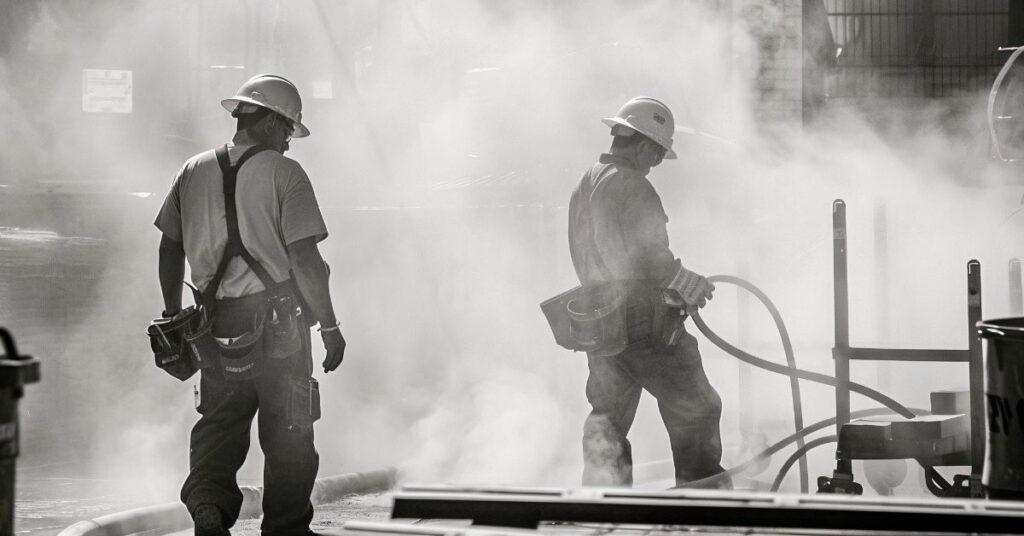
Sandblasting, also called abrasive blasting, looks simple from a distance: a worker in a hooded suit aiming a nozzle at a tank wall. Up close it is one of the higher-risk jobs on an oil and gas site. The abrasive leaves the nozzle at high speed, the equipment runs under pressure, the noise is intense, and the dust can include particles that cause permanent lung disease.
This guide explains the main hazards of abrasive blasting, the controls that should be in place before, during and after the job, the PPE blasters need, and the mistakes that cause most incidents. It is written for blasters, pot operators, supervisors and HSE officers working on refineries, tank farms, pipelines and fabrication yards.
Key takeaways
- Blasting dust can cause silicosis and other serious lung disease. NIOSH recommends that silica sand should not be used as a blasting abrasive and that safer media be used instead.
- The blaster needs an air-fed blasting helmet supplied with clean breathing air, not a dust mask.
- The blast nozzle must have a working dead man’s control, and the nozzle must never be pointed at anyone.
- Blast pots and hoses are pressure equipment and must be inspected and certified as per your site’s rules.
- Blasting in confined spaces needs a permit, ventilation, dust control, gas testing and a standby person.
What Is Abrasive Blasting?
Abrasive blasting uses compressed air to fire abrasive particles at a surface. On oil and gas sites it is used to:
- remove rust, scale and old coatings
- prepare steel surfaces before painting or coating
- clean the inside of tanks, vessels and pipes during shutdowns
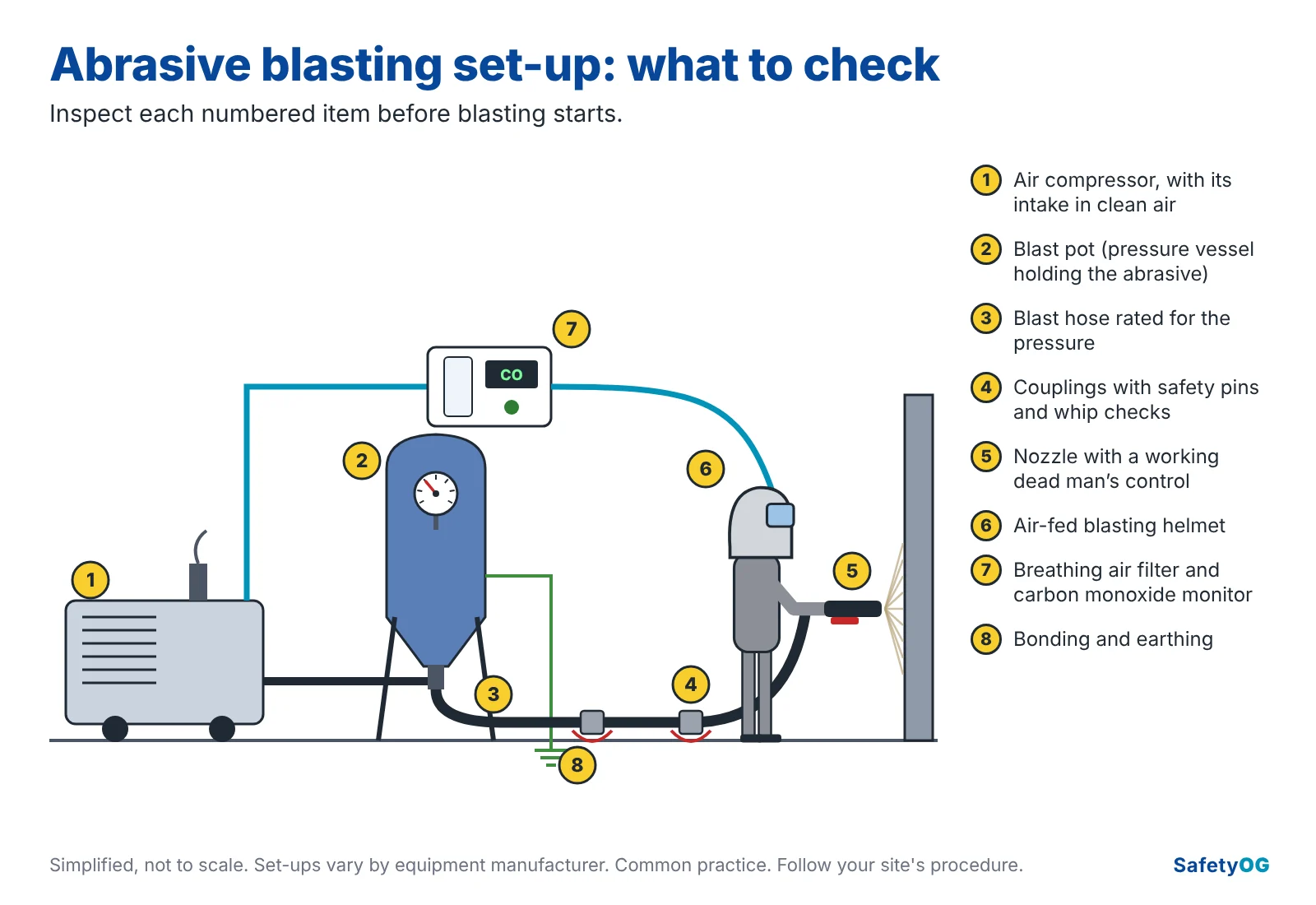
A typical set-up includes an air compressor, a blast pot (a pressure vessel that holds the abrasive), blast hoses and couplings, a nozzle with a dead man’s control, an air-fed helmet with its own clean air supply, and often a dust collector or extraction unit.
Major Hazards
Respiratory hazards: silica and toxic dust
This is the most serious long-term hazard. Blasting breaks abrasives and coatings into fine dust that can be breathed deep into the lungs.
- Crystalline silica from silica sand, and from some surfaces being blasted, can cause silicosis, an incurable lung disease, and is linked to lung cancer. NIOSH recommends banning silica sand, or any material containing more than 1% crystalline silica, as an abrasive blasting material, and using safer substitutes (NIOSH – Preventing Silicosis and Deaths From Sandblasting).
- Old coatings can contain lead or other toxic metals, which become airborne during blasting.
- Substitute abrasives such as garnet, steel grit or slag-based media are generally safer than silica sand, but can still produce harmful dust and may contain their own toxic metals. They still need dust controls and respiratory protection.
Many companies and some countries ban or restrict silica sand for blasting. Check your site’s rules and the SDS of the abrasive.
High-pressure injuries
The blast stream can tear skin and inject abrasive into the body. A hose that bursts or a coupling that separates can whip violently. Injuries can happen if:
- the nozzle is pointed at a person
- the dead man’s control is missing, damaged or tied down
- hoses and couplings are worn, mismatched or not secured with safety pins and whip checks
- the blast pot is opened or worked on while still pressurised
Noise
Compressors and the blast nozzle produce high noise levels that can cause permanent hearing loss. Noise also makes communication difficult, which is why hand signals and the dead man’s control matter so much.
Poor visibility and eye injuries
Rebounding abrasive and dust clouds can cause eye injuries and reduce visibility to almost nothing, both for the blaster and people nearby.
Heat stress
In a Gulf summer, a blaster in a heavy blasting suit and helmet, often inside a hot tank, is at high risk of heat illness. Work-rest cycles, cooled breathing air where available, and close monitoring are needed. See our guide to heat stress safety in the Gulf.
Confined space hazards
Blasting inside tanks and vessels adds the hazards of confined spaces: poor ventilation, build-up of dust, possible flammable or toxic atmospheres, and difficult rescue. It must be done under a confined space entry permit, with forced ventilation and dust extraction, gas testing and a trained standby person at the entrance. See fire watcher and hole watcher duties.
Static electricity
The flow of abrasive through hoses can build up static charge. Blasting equipment, hoses and nozzles should be bonded and earthed, especially near flammable atmospheres.
Slips, trips and falls
Spent abrasive on the ground is like walking on ball bearings. Work on scaffolds and inside tanks adds fall risks.
Control Measures
Work down the hierarchy of control. See our guide to risk assessment and the hierarchy of control.
Elimination and substitution
- Avoid blasting where another method can do the job, such as power tool cleaning for small areas.
- Use non-silica abrasives, checking the SDS for crystalline silica and toxic metal content.
- Consider wet blasting or vacuum blasting systems, which reduce dust.
Engineering controls
- Blast in enclosures or blast rooms where possible, or use screens and containment sheeting.
- Use dust collectors and forced extraction, especially inside tanks and vessels.
- Fit a working dead man’s control on every nozzle, so blasting stops the moment the blaster lets go.
- Use hoses, couplings and nozzles rated for the pressure, with safety pins and whip checks on every coupling.
- Inspect the blast pot as pressure equipment, with valid certification as per your site’s rules.
- Supply breathing air from a compressor with its intake in clean air, away from engine exhausts and dust, with filters and a carbon monoxide monitor or alarm as required by your site and the equipment manufacturer.
- Bond and earth the equipment.
Administrative controls
- Risk assessment, method statement and JSA for the job
- Permit to work, including a confined space entry permit for tank and vessel work. See our permit to work guide.
- Trained and authorised blasters and pot operators
- Barricade the blasting area and keep everyone else out
- Toolbox talk covering hazards, signals and emergency arrangements
- Work-rest cycles for heat and fatigue
- Health surveillance, such as lung function checks, where required by your company or local law
PPE: the last line of defence
| PPE | Purpose |
|---|---|
| Air-fed abrasive blasting helmet with a clean breathing air supply | Protects breathing, head, face and neck from dust and rebound |
| Heavy-duty blasting suit | Protects the body from rebounding abrasive |
| Heavy-duty blasting gloves | Protect hands from abrasion and rebound |
| Safety boots | Protect feet; slip-resistant soles on spent abrasive |
| Hearing protection worn under the helmet | Protects against noise |
| Respiratory protection for helpers and the pot operator | Protects people near the blast area from dust |
A dust mask alone is not suitable for the blaster.
Safe Work Procedure
Before blasting
- Permit, JSA and toolbox talk completed
- Area barricaded and signs in place
- Blast pot, hoses, couplings, whip checks, nozzle and dead man’s control inspected
- Breathing air supply checked: compressor intake position, filters and CO monitoring
- Equipment bonded and earthed
- PPE inspected and fitted
- For confined spaces: gas test, ventilation and extraction running, standby person in place, rescue plan agreed
During blasting
- Never point the nozzle at anyone, even with the air off
- Keep the dead man’s control working. Never tie it down or bypass it.
- Use agreed hand signals with the pot operator
- Watch for leaks, worn hoses or loose couplings, and stop if you see one
- Follow work-rest cycles and watch each other for signs of heat stress
- Stop immediately if the breathing air supply is interrupted
After blasting
- Depressurise the blast pot and hoses before disconnecting anything
- Clean up spent abrasive and dust, using vacuum methods rather than dry sweeping or compressed air where possible
- Dispose of spent abrasive as per the site’s waste procedure, especially if it contains lead or other toxic coatings
- Store equipment properly and report defects
- Remove and clean PPE before eating or drinking
Emergency Procedure
- Stop blasting immediately if there is an injury, equipment failure or loss of breathing air
- Make the equipment safe: release the dead man’s control and depressurise
- Give first aid if trained, and call the emergency response team
- For confined spaces, the standby person raises the alarm and starts non-entry rescue, and never enters
- Report the incident to the supervisor and HSE
- Do not restart until the area is safe and the permit has been revalidated
Illustrative Scenarios
Illustrative example: the tied-down dead man’s control. To reduce hand fatigue, a blaster tapes down the dead man’s lever. Later he slips on spent abrasive and drops the hose, which whips around while still blasting. With a working dead man’s control, blasting would have stopped the moment he let go.
Illustrative example: the compressor intake. The breathing air compressor is parked downwind of a diesel generator. Exhaust is drawn into the air supply to the blasting helmet, and the blaster starts to feel dizzy. A CO monitor on the breathing air line and correct positioning of the compressor intake prevent this.
Illustrative example: blasting inside a tank in summer. A crew blasts inside a crude oil tank in mid-afternoon. The extraction fan is undersized and dust builds up, while the temperature inside climbs. The job should have proper ventilation, dust extraction, work-rest cycles based on conditions inside the tank, and a standby person trained to spot heat illness.
Common Mistakes and How to Fix Them
| Mistake | Fix |
|---|---|
| Using a dust mask instead of an air-fed helmet | Use an approved air-fed blasting helmet with clean breathing air |
| Using silica sand | Use safer abrasives; check the SDS for silica content |
| Tying down or bypassing the dead man’s control | Never. Replace faulty controls before work. |
| Missing safety pins or whip checks | Fit them on every coupling and check before each use |
| Ignoring small air leaks | Stop and repair. Leaks can lead to hose failure. |
| Opening a pressurised blast pot | Always depressurise fully first |
| Dry sweeping spent abrasive | Use vacuum methods to avoid raising dust |
| No barricade around the blast area | Barricade and keep others out |
FAQ
Why is silica sand dangerous for blasting? Silica sand breaks into fine crystalline silica dust that can be breathed deep into the lungs, causing silicosis, an incurable lung disease, and increasing the risk of lung cancer. NIOSH recommends that silica sand, or any abrasive with more than 1% crystalline silica, should not be used for abrasive blasting.
What PPE does a sandblaster need? An air-fed abrasive blasting helmet supplied with clean breathing air, a heavy-duty blasting suit, blasting gloves, safety boots and hearing protection worn under the helmet. People working nearby, including the pot operator, also need suitable respiratory protection. A dust mask alone is not enough for the blaster.
What is a dead man’s control on a blast nozzle? It is a spring-loaded lever or switch at the nozzle that the blaster must hold down to keep blasting. As soon as it is released, the blast stops. It prevents an uncontrolled nozzle if the blaster slips, drops the hose or is injured.
Can abrasive blasting be done in a confined space? Yes, but only under a confined space entry permit with forced ventilation and dust extraction, gas testing, a trained standby person at the entrance, a rescue plan, and suitable PPE including air-fed helmets. Heat stress must also be managed, especially in hot climates.
How should spent abrasive be disposed of? According to the site’s waste management procedure and local environmental rules. Spent abrasive can contain old paint with lead or other toxic metals, so it may need to be treated as hazardous waste. Collect it with vacuum methods to avoid raising dust.
Conclusion
Abrasive blasting can be done safely, but only when every control is in place: safer abrasives, a working dead man’s control, certified pressure equipment, clean breathing air, barricades and trained people. Before the next blasting job, check the dead man’s control, the whip checks and where the compressor intake is. Then read our guides to the permit to work system and PPE in the oil and gas industry.
Related reading
- H2S safety training for oil and gas
- General safety induction for oil and gas plants
- Hand safety, line of fire and dropped objects
Last reviewed: October 2026. General guidance only. Follow your site’s abrasive blasting procedure and permit system.
About the author

Adil Ahmed — HSE Officer. 4+ years across oil and gas EPC projects, drilling rig operations, refinery operations, brownfield tank farm expansion and shutdown/turnaround (TAR) work in the Middle East and South Asia, covering permit to work, JSA/JHA, risk assessment, confined space entry, lifting operations and hot work.
Qualifications: NEBOSH International General Certificate in Occupational Health and Safety · IOSH Managing Safely
See project experience → · Follow SafetyOG on LinkedIn
General guidance only. Standards and requirements vary by company, country and permit system — always follow your own site’s approved procedure.